

Women Artists of Woods Hole: Selections from the Permanent Collection
An Exhibit Inspired by Marcella Garber Polisar Katz
The Summer 2025 exhibit showcased works by Woods Hole women artists from the museum’s permanent collection, spanning nearly 150 years. Using a variety of techniques, including watercolor, oils, lithography and pen-and-ink, these talented women created art that invites the viewer into Woods Hole.
The exhibit was inspired by longtime summer resident Marcella Garber Polisar Katz (1923-2023), who understood the importance of collecting works by her contemporaries in Woods Hole. A pioneering scientist herself, Marcella Katz was a lifelong advocate for women’s equal societal roles. We are grateful to the daughters of Marcella and her husband, George—Martha Ellen Katz and Barbara Ethel Katz Green—for donating pieces from their parents’ collection to the museum, as well as loaning several other works, as an expression of their mother’s community values, highlighting both recognized and unrecognized Woods Hole women artists.
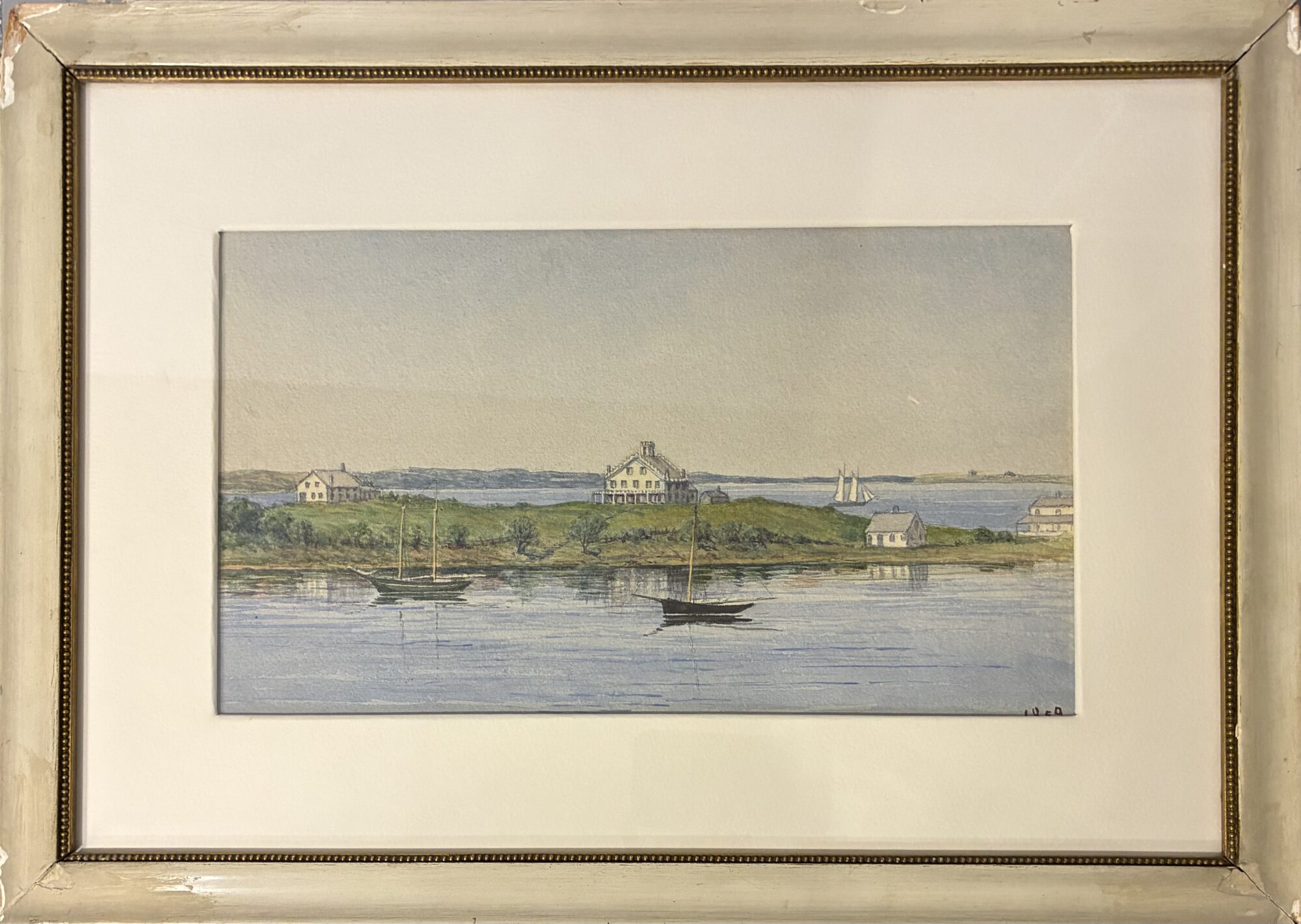
Maria Denny Fay
Little Harbor with Webster House on Butler’s Point, 1859
Maria Denny Fay (1820-1890)
Watercolor on paper
Maria Denny Fay was the sister of Joseph Story Fay and the youngest of the seven children of Samuel and Harriet Fay. She lived in Cambridge, Massachusetts, for her entire life. She was educated at the Ursuline Academy in Charlestown, traveled widely, studied German and loved to play the piano. By her own and family members’ accounts, Maria was completely uninterested in marriage and instead wholly focused on her many creative and adventurous pursuits.
In this painting, Maria captures the serenity of the harbor through cool colors and delicate paint strokes. The viewer is placed on the water, as if on a boat on Little Harbor looking at Butler’s Point, now known as Juniper Point. Today, Juniper Point is home to more buildings than in Maria’s time, but her painting reflects the timeless beauty of Woods Hole’s landscapes.
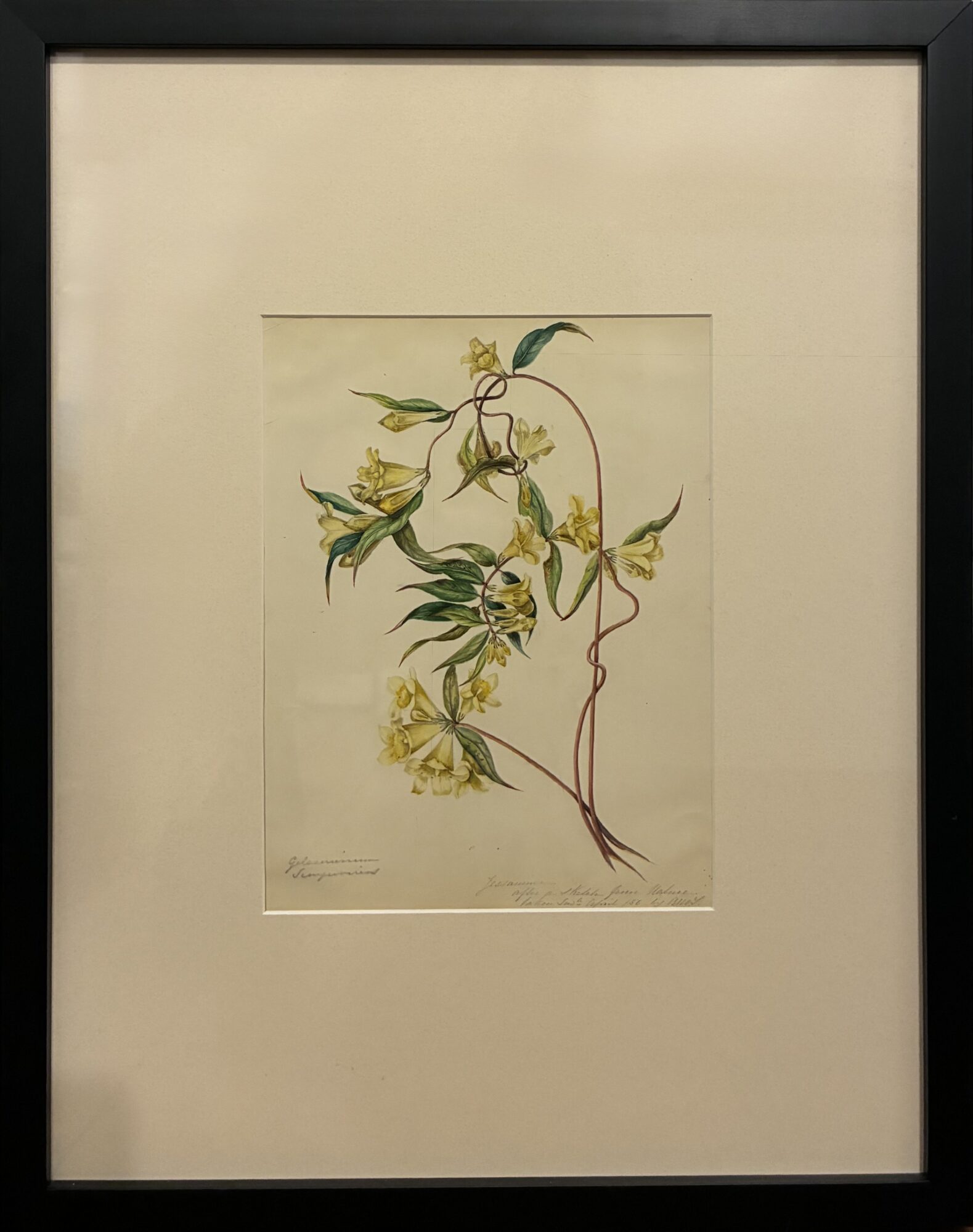
Anna Maria Fay
Carolina Jessamine, After a Sketch from Nature, 1856
Anna Maria Fay (1828-ca. 1922)
Watercolor on paper
Anna Maria Fay was the daughter of Samuel Howard Fay and niece of Joseph Story Fay. She was born in Savannah, Georgia, and lived in New York City for much of her life. When her sister Clara Fay Hill Smith died in 1881, Anna Maria assumed care of her four children and moved into her home in Falmouth. This move, however, caused somewhat of a scandal in the community, as Clara’s husband Frank continued to live in the house as well, and despite living together, Anna Maria and Frank never married.
Anna Maria was highly educated in literature, music and art. Her talent for the latter is clear in this botanical illustration, which dynamically depicts Carolina jessamine, the state flower of South Carolina, in vibrant color.
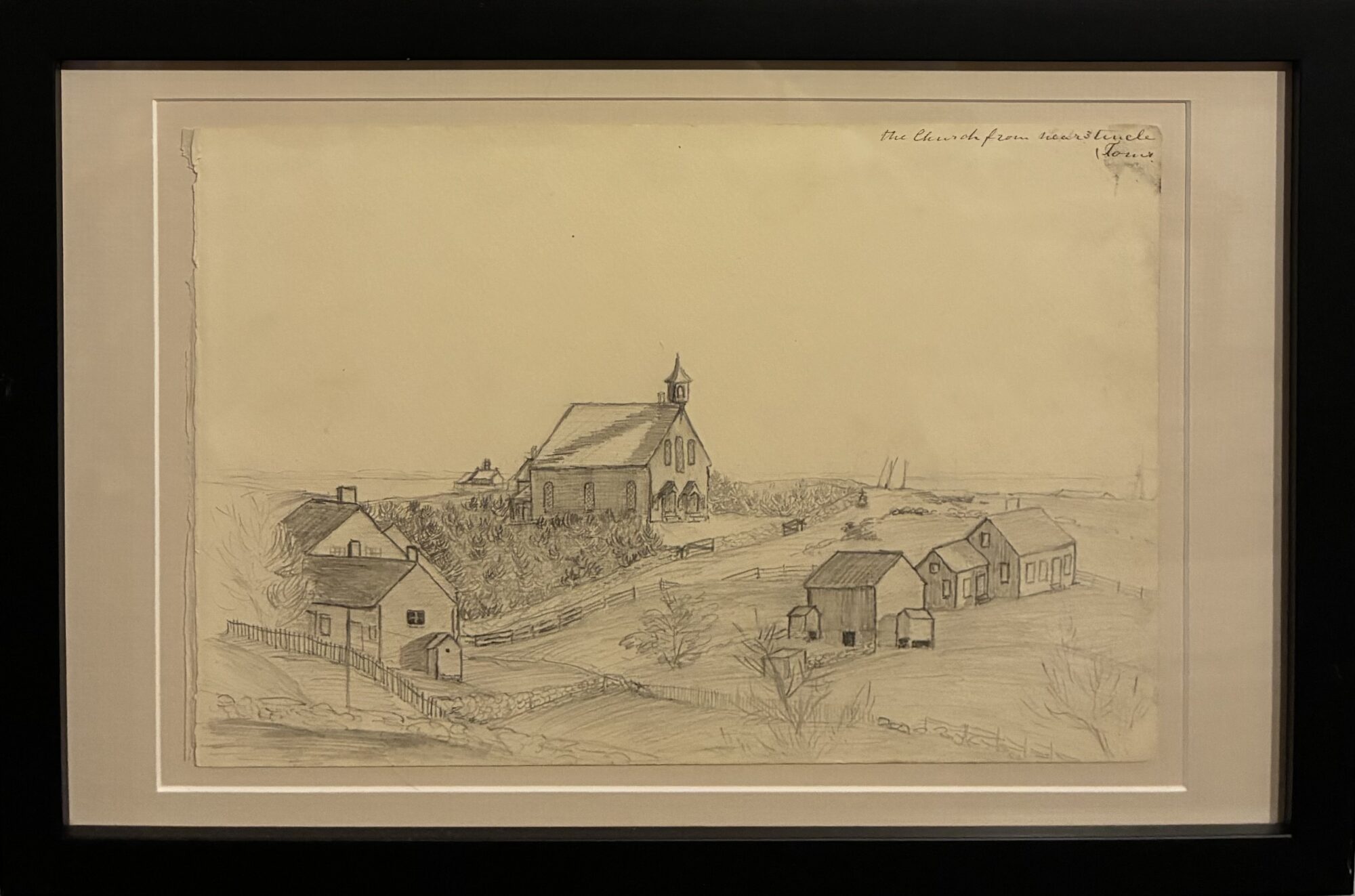
Sarah Bryant Fay
The Church from near Uncle Tom’s (Hamlin Houses and Original Church of the Messiah), late 19th century
Sarah Bryant Fay (1856-1936)
Graphite on paper
Sarah was the youngest child of Joseph Story Fay and Sarah Bryant Fay. She spent much of her life in the South because of her delicate constitution. She never married and was quirky, witty, a beloved aunt, and a talented watercolorist and photographer. She captured many village scenes that are archived here at the Woods Hole Historical Museum. Catboats, local buildings and the famed family rose garden were all subjects of her interest.
This drawing captures a view looking down Church Street towards the original wooden Church of the Messiah. Constructed in 1852, the wooden building was used until 1889, when Joseph Story Fay commissioned a stone replacement on the same site, which is used to this day. Pictured in the background to the left of the church is the original 1828 Nobska lighthouse.
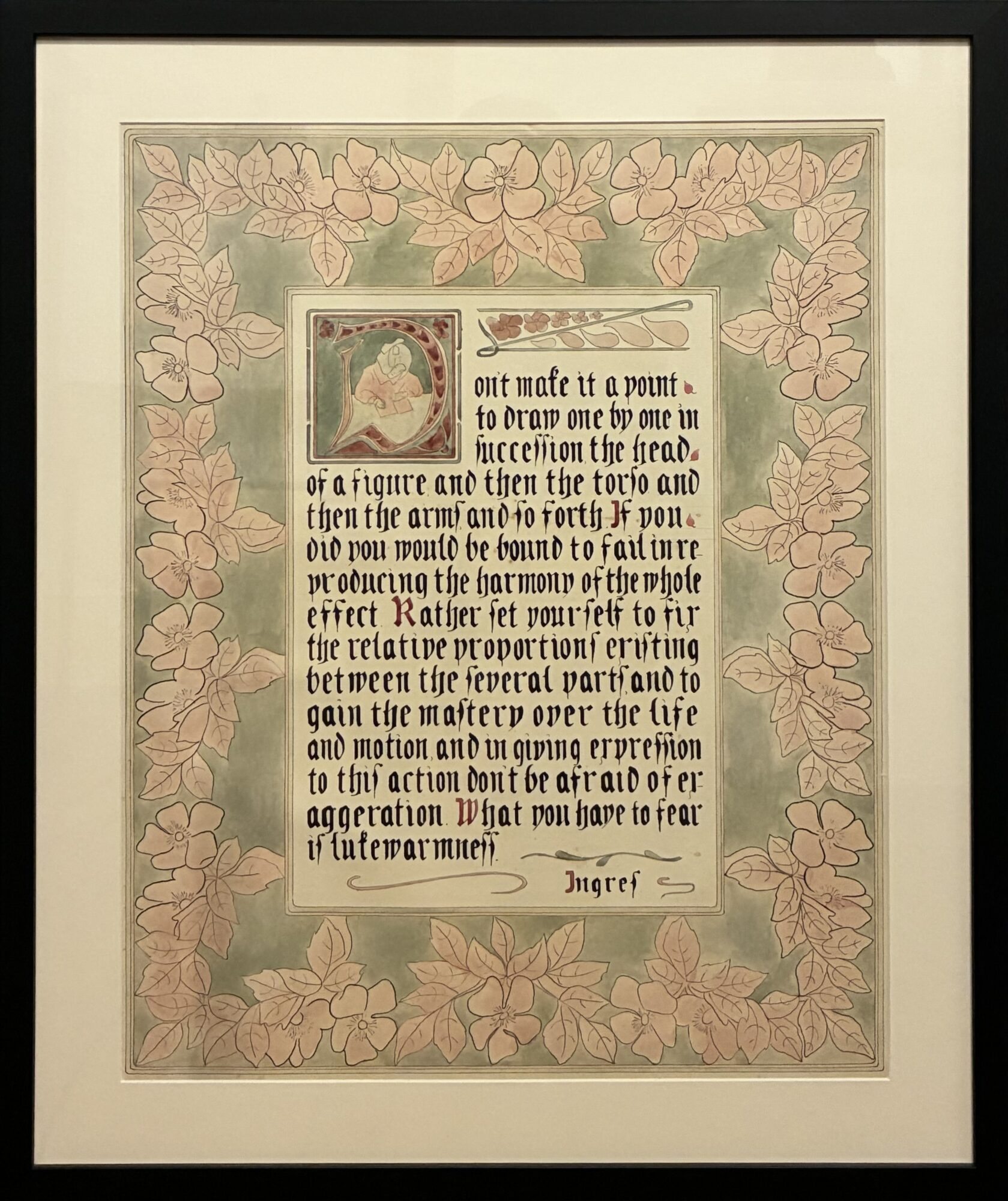
Persis Addy Crowell
Student Exercise, ca. 1885-1890
Persis Addy Crowell (1869-1960)
Watercolor and ink on paper
This illuminated manuscript was part of a portfolio of student watercolor artwork, which was donated to the museum by Margaret and Ivor Cornman in 1987. It showcases the beautiful calligraphy and drawing of Persis Crowell, a longtime resident of Woods Hole.
Crowell was the daughter of Hannah and Azariah F. Crowell, the chief scientist for the Pacific Guano Company (see panel on rear wall). She was one of the first students at the Woods Hole School and, after graduating art school in Boston, became an art teacher in Attleboro, Massachusetts. She returned to Woods Hole upon her retirement and lived with her sisters at the family home on Water Street on the hill across from the post office, now WHOI’s Crowell House.
She was a member of the Woods Hole Woman’s Club, which established a program to honor its deceased members with the gift of a book donation to the library. Crowell designed a beautiful floral bookplate for these memorial donations.
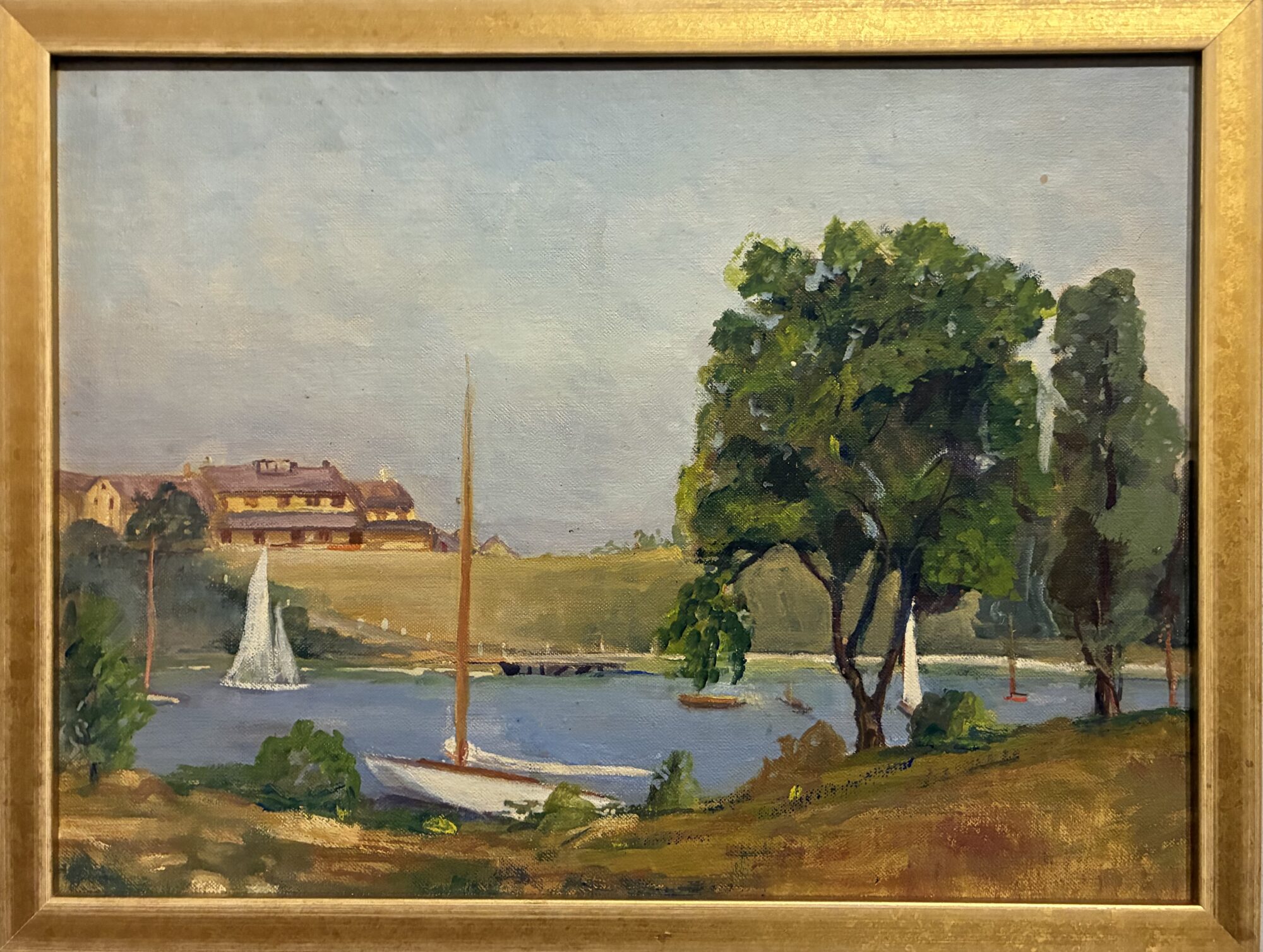
Sarah Anne Bimm Fay
Quissett Harbor House, mid-20th century
Sarah Anne Bimm Fay (1888-1971)
Oil on academy board
Sarah grew up in Dayton, Ohio, and married “Harry” Henry Fay, Jr. in 1917. During World War I, while Harry was fighting in France, Sarah volunteered for the war effort at home. The couple later moved to Concord, Massachusetts, living in the Elisha Jones House, known as the “Bullet Hole House” after it was struck by a British musket ball during the Battle of Lexington and Concord.
Harry and Sarah often visited their Fay family relatives in Woods Hole. Sarah played tennis and participated in activities with the Church of the Messiah. She raised funds for the “Falmouth Fete” in 1960 to support the Visiting Nurse Association. Her passion was painting, and she had a special relationship with her granddaughter, Fay Woodruff, teaching her how to paint.
This painting of Quissett Harbor House, located off Woods Hole Road, depicts the hotel prior to the demolition of portions of the complex after the hotel’s closure in 1975. For most of its 100 years of operation, the hotel was owned by the Carey family, who enabled the Quissett Harbor House Land Trust to purchase the remaining central portion of the hotel and save the property from development.
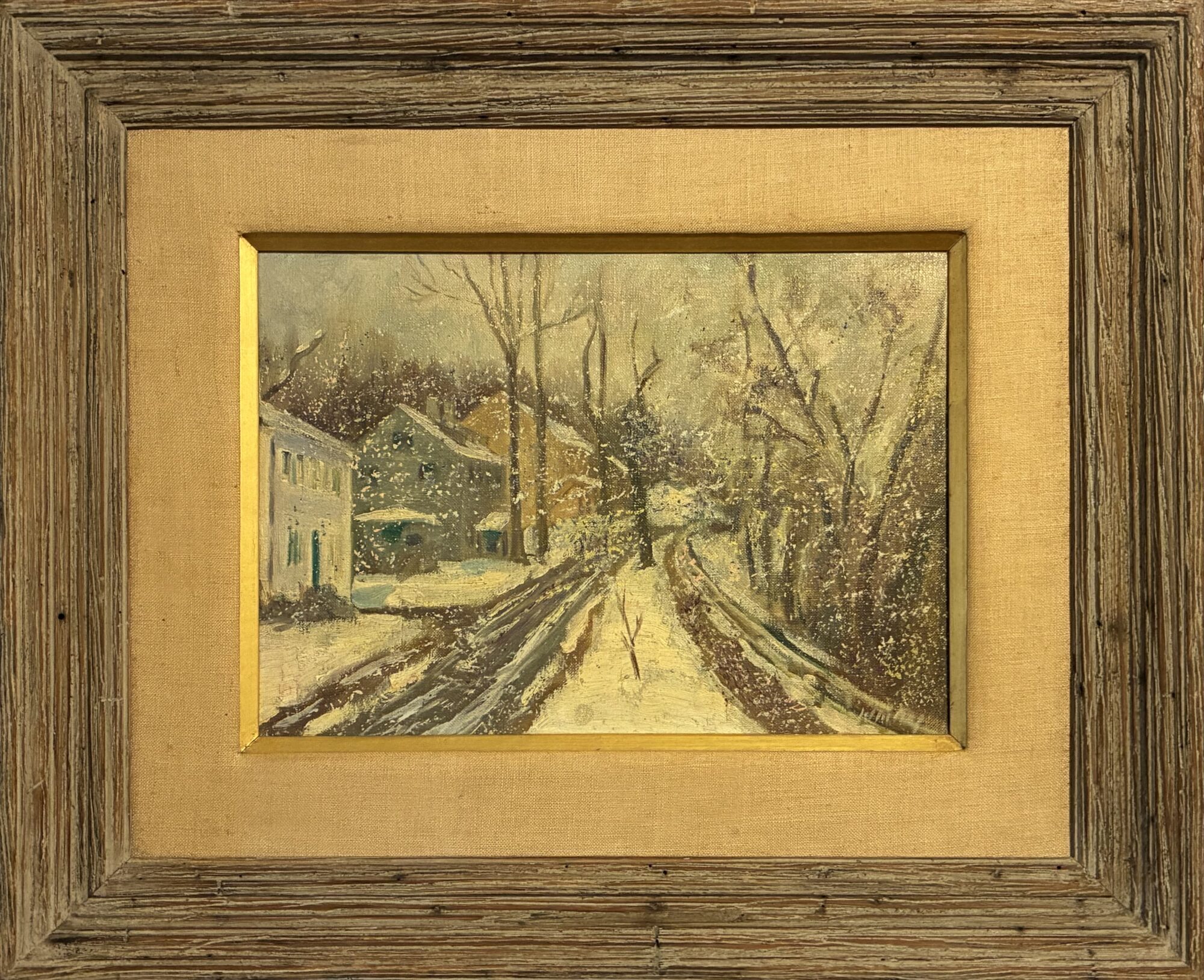
Gertrude Whiting
Main Road, Woods Hole, mid-20th century
Gertrude Whiting (ca. 1899-1981)
Oil on canvas
Whiting was a distinguished painter known for her portraits of noted individuals like Dame Judith Anderson, Jimmy Durante and Roger Tory Peterson. Her portrait of MBL scientist Dr. E.G. Conklin hangs in the reading room of the MBLWHOI Library.
Whiting was an artist in residence at Chatham Hall, Virginia, where she taught classes in art and history. She was beloved by her students, one writing, “I loved escaping to art class and having her wander amongst our easels, supportively watching over our shoulders, and quietly encouraging our efforts. I learned to see objects and shapes more analytically and to appreciate the wonderful compositions found in life.”
In the 1950s, Whiting spent summers in Woods Hole. She rented Bradley House, the building we’re in now, from the Wood Hole Public Library, and it became her home, studio, and gathering place for friends and students.
This wonderful winter landscape, a departure from her typical portraiture, depicts the houses on Woods Hole Road looking north.
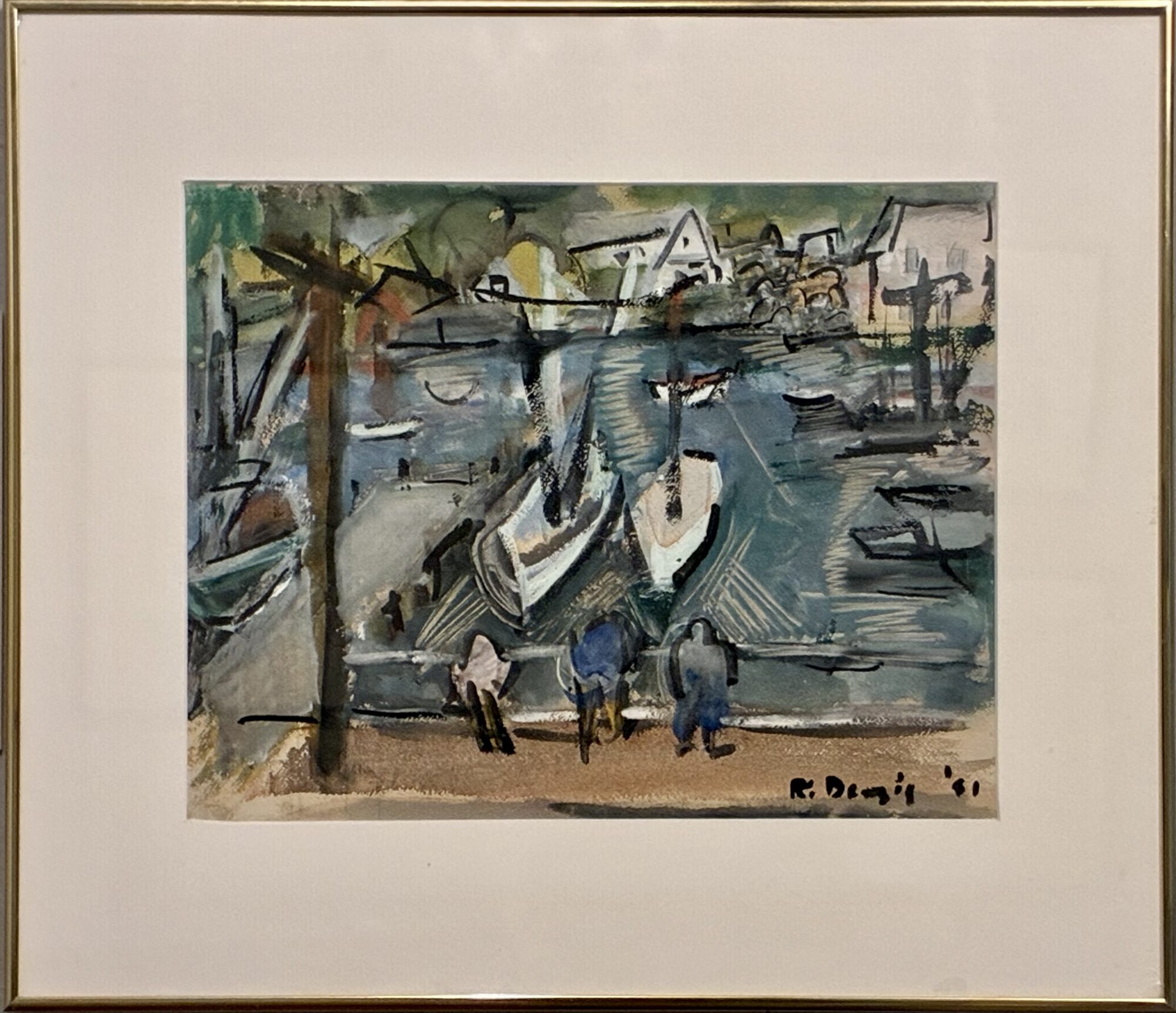
Rose Danzig Grundfest
Untitled, 1981
Rose Danzig Grundfest (1906-1999)
Watercolor on paper
Eel Pond is a beloved subject for local painters. In this painting, Danzig Grundfest captures an abstract view of two sailboats by the dock and of people standing by.
Danzig Grundfest was born in Gunnison, Mississippi. In 1926, she married Harry Grundfest, who became a renowned professor of neurology at Columbia University. The couple and their daughter, Brooke Grundfest Schoepf, spent summers in Woods Hole, where Harry conducted research at MBL.
It was here in Woods Hole where Danzig Grunfield joined the local art scene. She enjoyed painting outdoors alongside William Littlefield and Ellen Donovan. She not only showed talent as a painter but also as a sculptress.
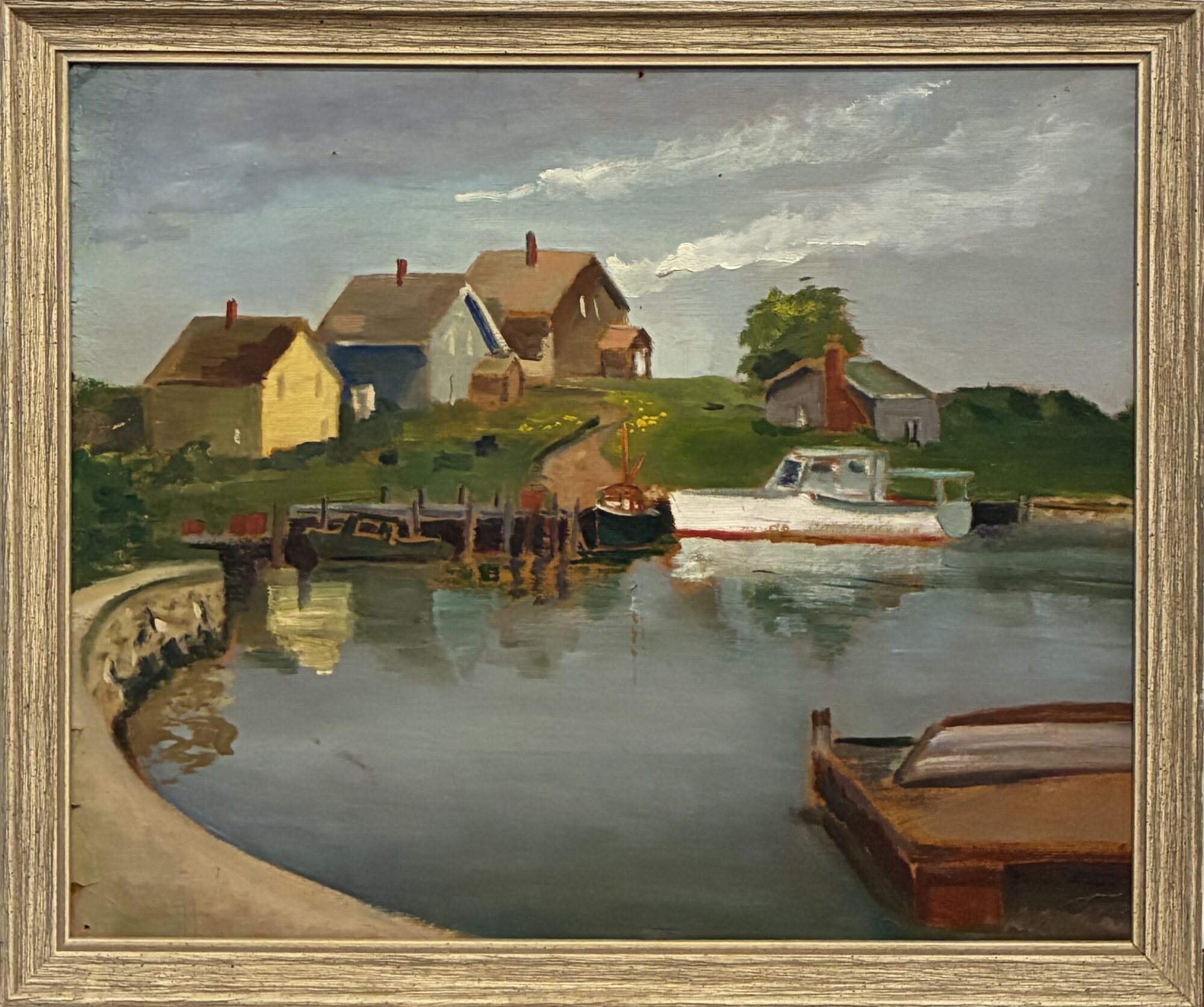
Caroline Wheeler
DoReMi Houses, mid-20th century
Caroline Wheeler (ca. 1911-2004)
Oil on canvas
Born in New Milford, Connecticut, Wheeler attended Bryn Mawr College in Pennsylvania. After graduating, she worked in New York City. In 1940, Wheeler moved to Woods Hole with her husband, Charles, a biologist and director of the aquarium at the National Marine Fisheries Service, now NOAA Fisheries. In World War II, when the U.S. Navy took control of much of the Woods Hole waterfront, she worked on several WHOI projects relating to the war effort.
Wheeler was one of the founders of the Falmouth Artists Guild (now the Falmouth Art Center), established in 1966 when a small group of Falmouth painters gathered and began informal art classes. She was also a member of the Falmouth Woman’s Club. Wheeler loved Falmouth and Woods Hole, particularly Falmouth Harbor and Eel Pond. She donated this painting of the iconic DoReMi houses to the Woods Hole Historical Museum in 1981.
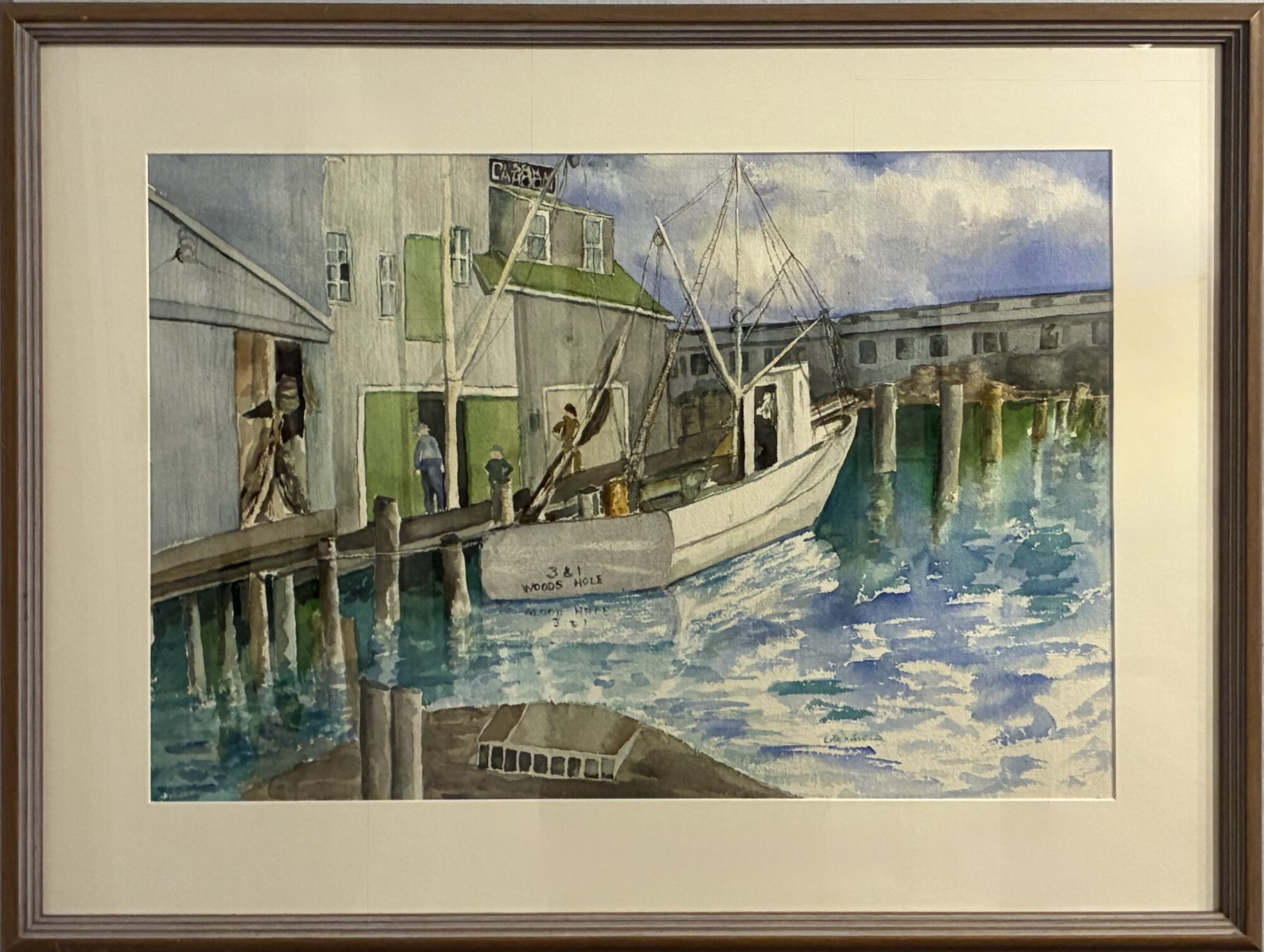
Lola Robertson
Boats at Cahoon’s Fish Market, mid-20th century
Lola Robertson (1911-2007)
Watercolor on paper
This watercolor portrays a trawler docked at Sam Cahoon’s Fish Market, a Woods Hole business active from 1916 to 1966. To the right, the artist has included a train from the Old Colony Railroad, which transported both passengers and goods to the village, and is now the Shining Sea Bikeway.
Lola Robertson was a native of Memphis, Tennessee. After being trained in art, she studied biology at Southwestern at Memphis (now Rhodes College). She first experienced the charm of Woods Hole as an under-graduate, taking the MBL embryology course in 1931. For more than 50 summers, she served as a lab technician and illustrator at the MBL in Woods Hole for New York University parasitologist Dr. Horace Stunkard.
Working in Peoria, Illinois, during World War II, Robertson helped to advance the large-scale manufacture of penicillin. Married to a biologist who taught for most of his career in Evansville, Indiana, she later pursued a 20-year career in special education. A scholarship has been established in her name at the MBL, and the biological sciences building at her alma mater is named for her and her spouse.
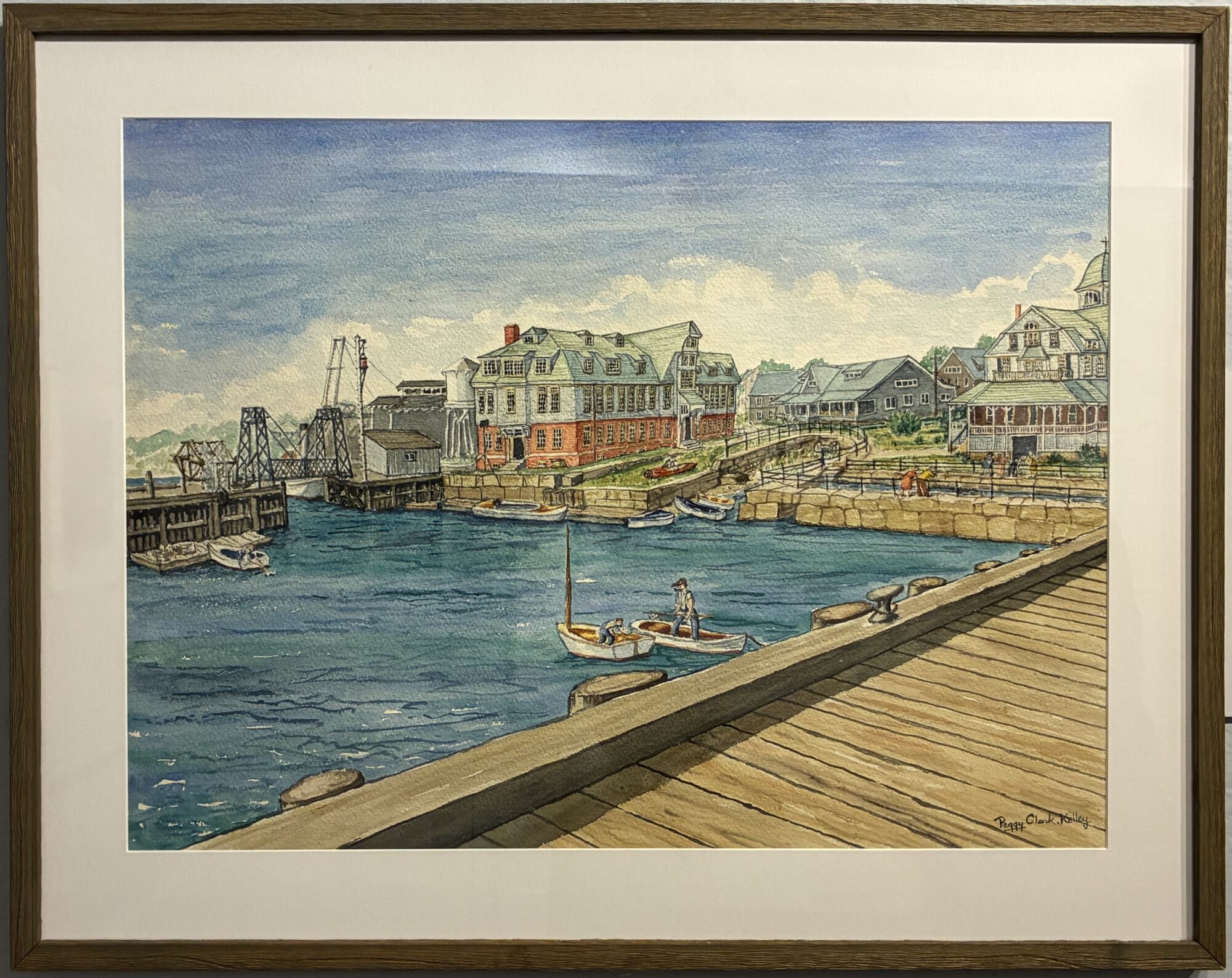
Peggy Clark Kelley
Fisheries Buildings, ca. 1938
Peggy Clark Kelley (1915-1996)
Watercolor on paper
From her childhood, Kelley spent summers in Woods Hole with her family on Albatross Street, across from the U.S. Fisheries buildings. Inspired by her love of the village, she often created beautifully executed watercolor renderings of local landscape views and architecture. This example depicts the former U.S. Fisheries compound, including a glimpse of the outdoor seal tank on the right, now the location of the Woods Hole Science Aquarium.
Professionally, Kelley was a designer of theatrical lighting, scenery, and costume. She worked on over 75 Broadway shows, including Brigadoon, Peter Pan and Bye, Bye Birdie, and served in 1968 as the first woman president of her labor union, The United States Scenic Artists, Local 829. A collection of materials related to her extensive career, including light plots, scenic renderings, published and unpublished writings, blueprints and photographs, is in the Library of Congress.
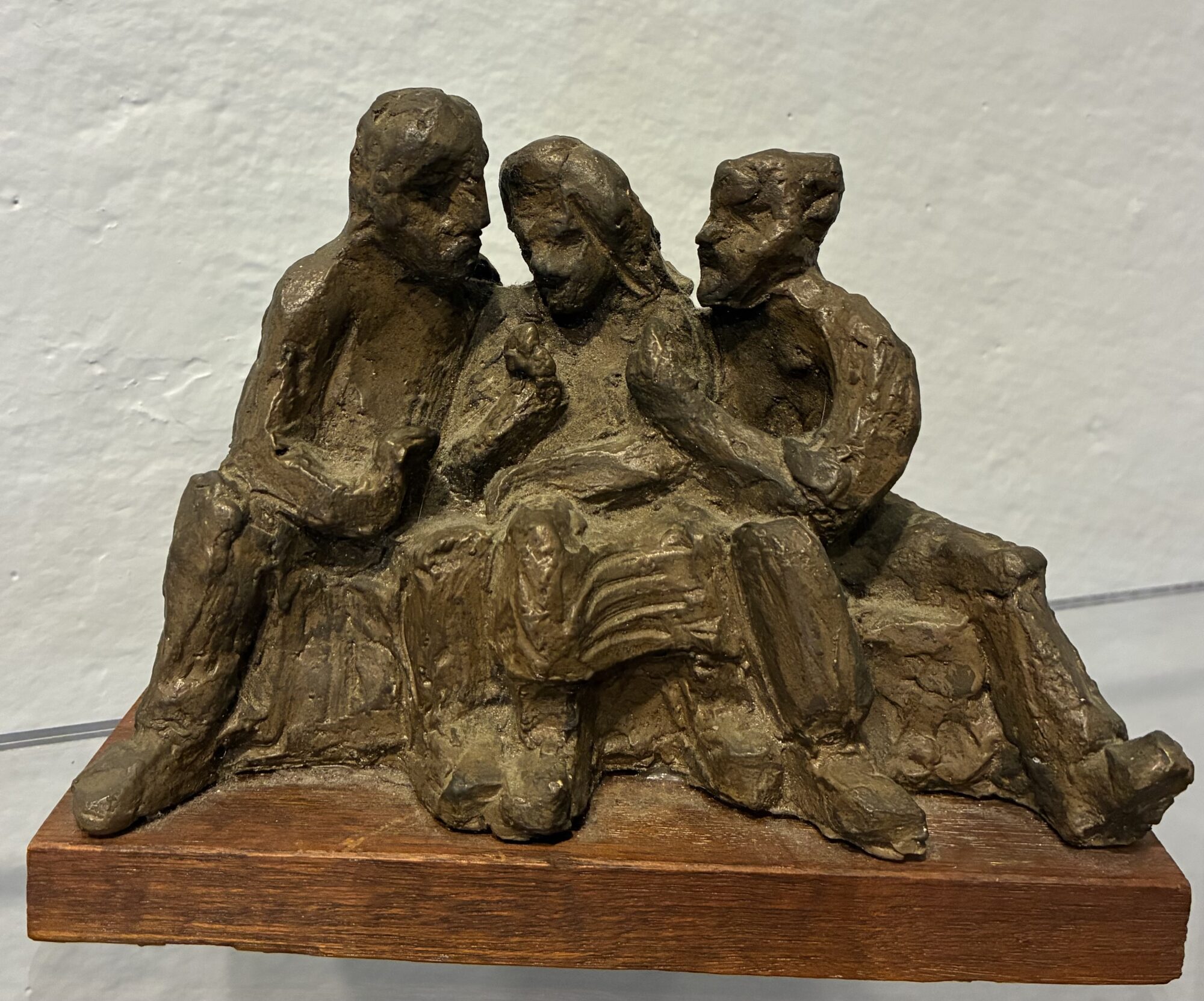
Elaine Pear Cohen (1 of 2)
Elaine Pear Cohen (1920-1995)
Cohen lived and worked in the Woods Hole/Falmouth community as a summer and permanent resident for nearly 50 years. Elaine studied at Bennington College in Vermont and with Ossip Zadkine in Paris, France. She was an art teacher at Friends Central School in Philadelphia. After leaving Friends Central, she taught the art education classes at the Philadelphia College of Art. In her studio practice, she worked on commissions for private and public art locations.
Study for The Scientists, 1980
On loan from Ruth Straus Gainer
Cohen made this small-scale model, known as a maquette, in preparation for creating her life-size sculpture The Scientists for MBL. Located on Main Street in Woods Hole next to the Candle House, the sculpture is part of MBL’s permanent art collection.
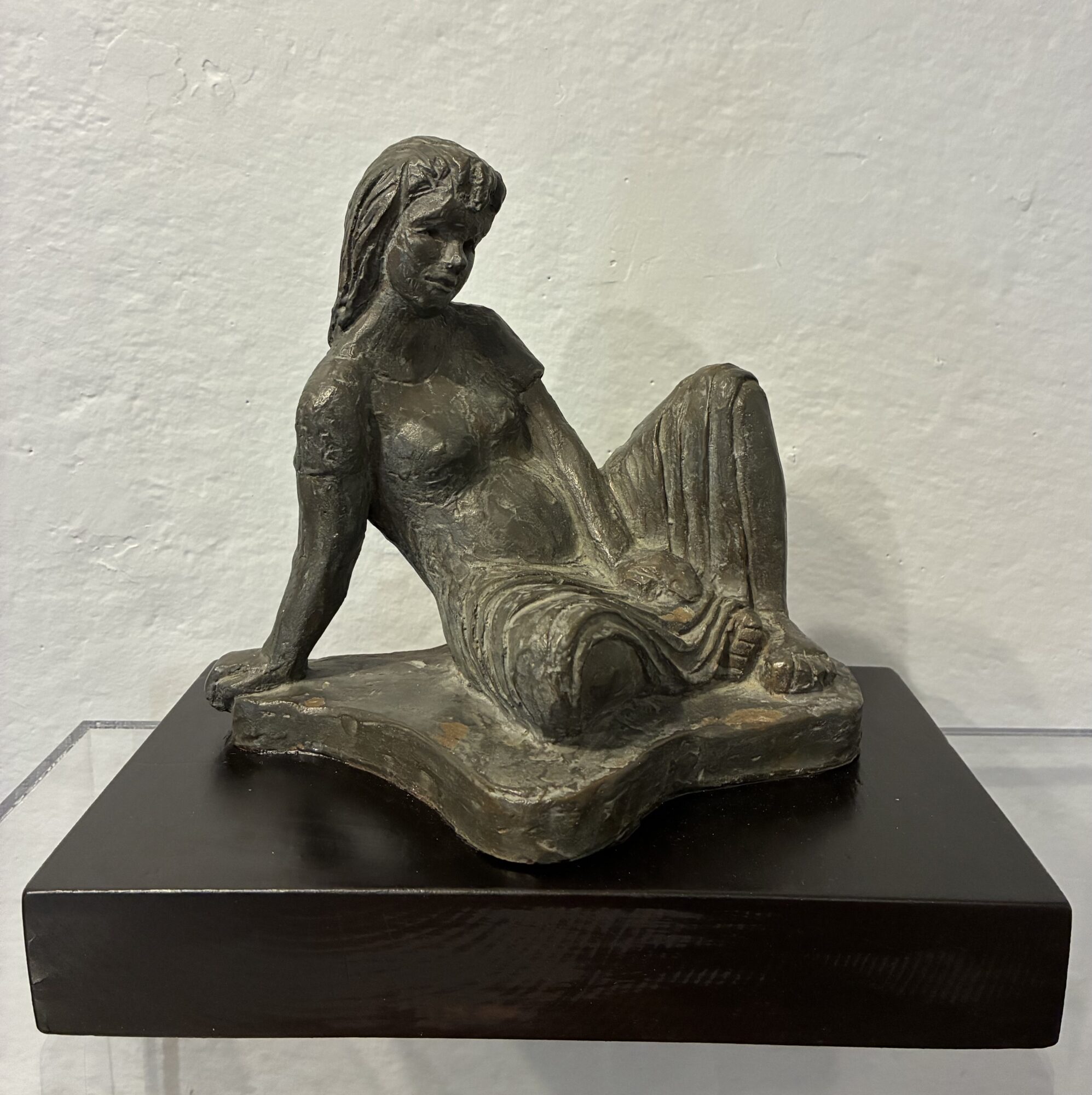
Elaine Pear Cohen (2 of 2)
Seated Girl, 1979
On loan from Martha Ellen Katz
This sculpture portrays a young woman looking thoughtfully out on the water. Cohen’s contemplative portraits show us an interior life as well as the experience of relating to the sculpture on an aesthetic level. The portraits hold a meditative viewpoint of what it means to consider our identity and contribution to society.
“Portraits are an indispensable part of the arts vocabulary. The subject potential of vulnerability, or feelings of urgency, or of disappointment, or of hope—these are what the public needs to see in order to identify that the person was a living coping being.”
—Elaine Pear Cohen, “The Art of Honoring”
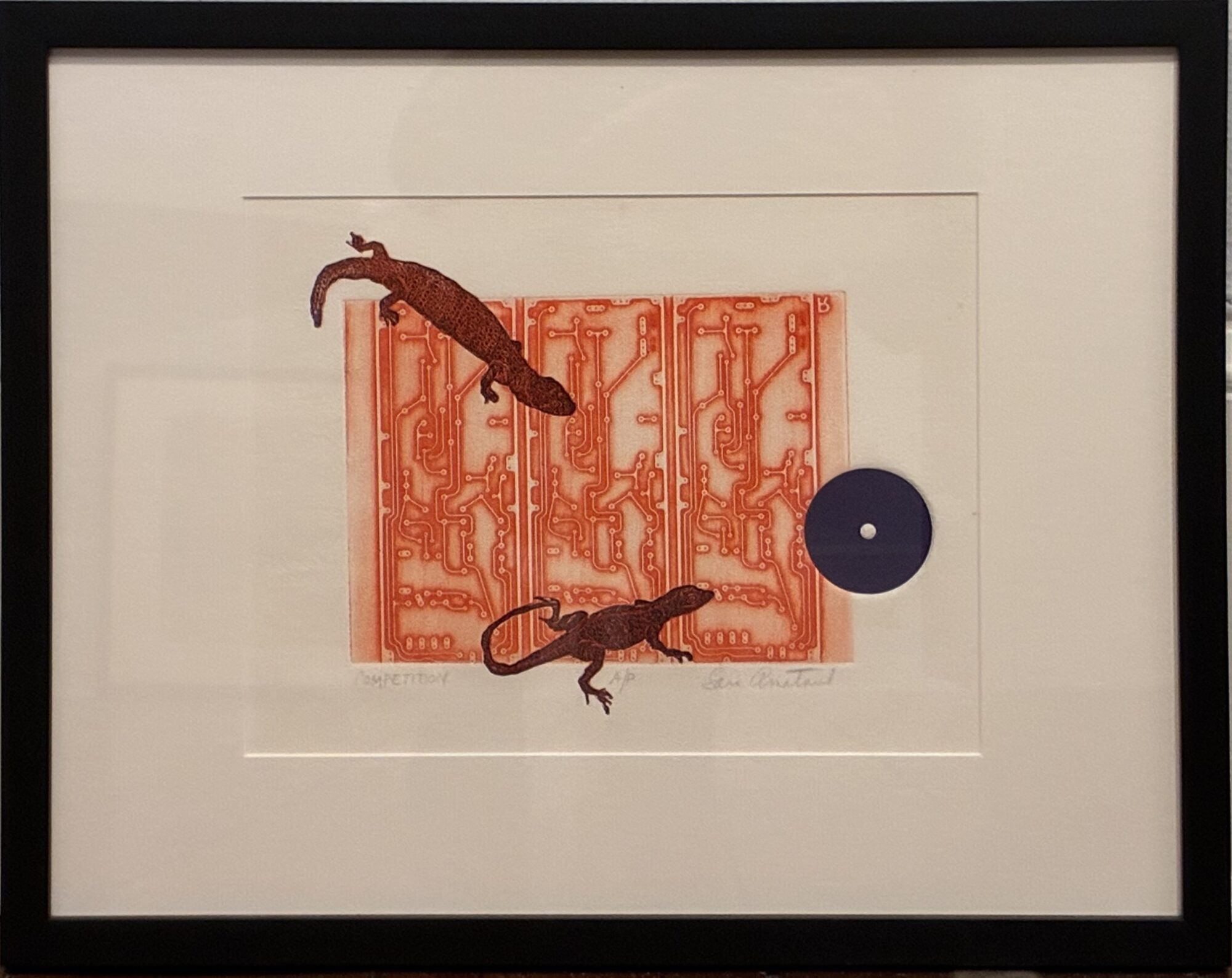
Sara Berlin Amatniek
Competition, 1972
Sara Berlin Amatniek (1922-1996)
Etching print on paper
Born in New York City, Amatniek received her undergraduate degree from Brooklyn College and her master’s degree from Columbia University. She also studied printmaking at Pratt Institute. In 1949, she married Ernest Amatniek, an electrical engineer, who later worked with Professor Harry Grundfest at Columbia. The collaboration with Grundfest, a researcher at MBL, brought the couple to Woods Hole.
Created relatively early in her printmaking career, Competition is one of a series of prints inspired by the post-apocalyptic 1959 novel A Canticle for Leibowitz, written by Walter M. Miller, Jr. The main character, Leibowitz, had been an electrical engineer, symbolized by the circuit board depicted in the print. Salamanders appear in the novel as evil spirits.
Amatniek was a pioneer in the use of found objects in printmaking, such as circuitry, lace, clock dials and old coins. Her monotypes of tiger lily images are among the most popular and dynamic products of this labor-intensive process. Her award-winning work has been shown in Egypt, Israel, India and New York City. Amatniek was also active in the second-wave feminist movement.
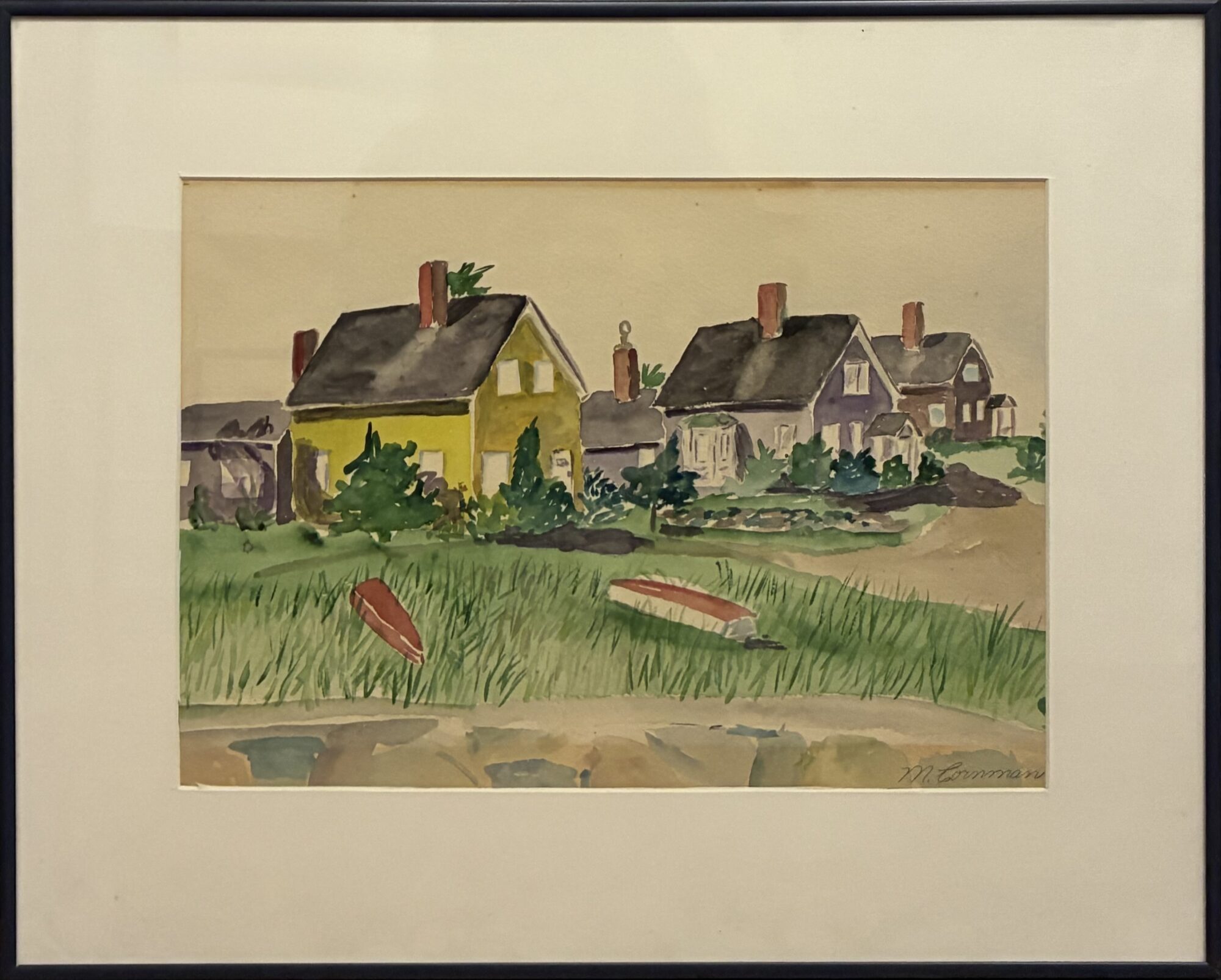
Margaret E. Cornman
DoReMi Houses, c. 1950
Margaret E. Cornman (1923-2011)
Watercolor on paper
Cornman, familiarly known in the village as Mege (pronounced “Midge”), and her husband Ivor Cornman were long-time residents of Woods Hole. Originally brought to the village by Ivor’s position as a researcher at MBL, the couple spent summers in Woods Hole, and, after her husband’s passing, Cornman moved to Falmouth full time in 2003. The Cornmans were very active in the community, volunteering faithfully at the hospital thrift shop in Falmouth and belonging to several local dance groups.
In this colorful watercolor, Cornman has painted the DoReMi Houses. These small cottages were situated on Eel Pond where MBL’s Swope Center is located today.
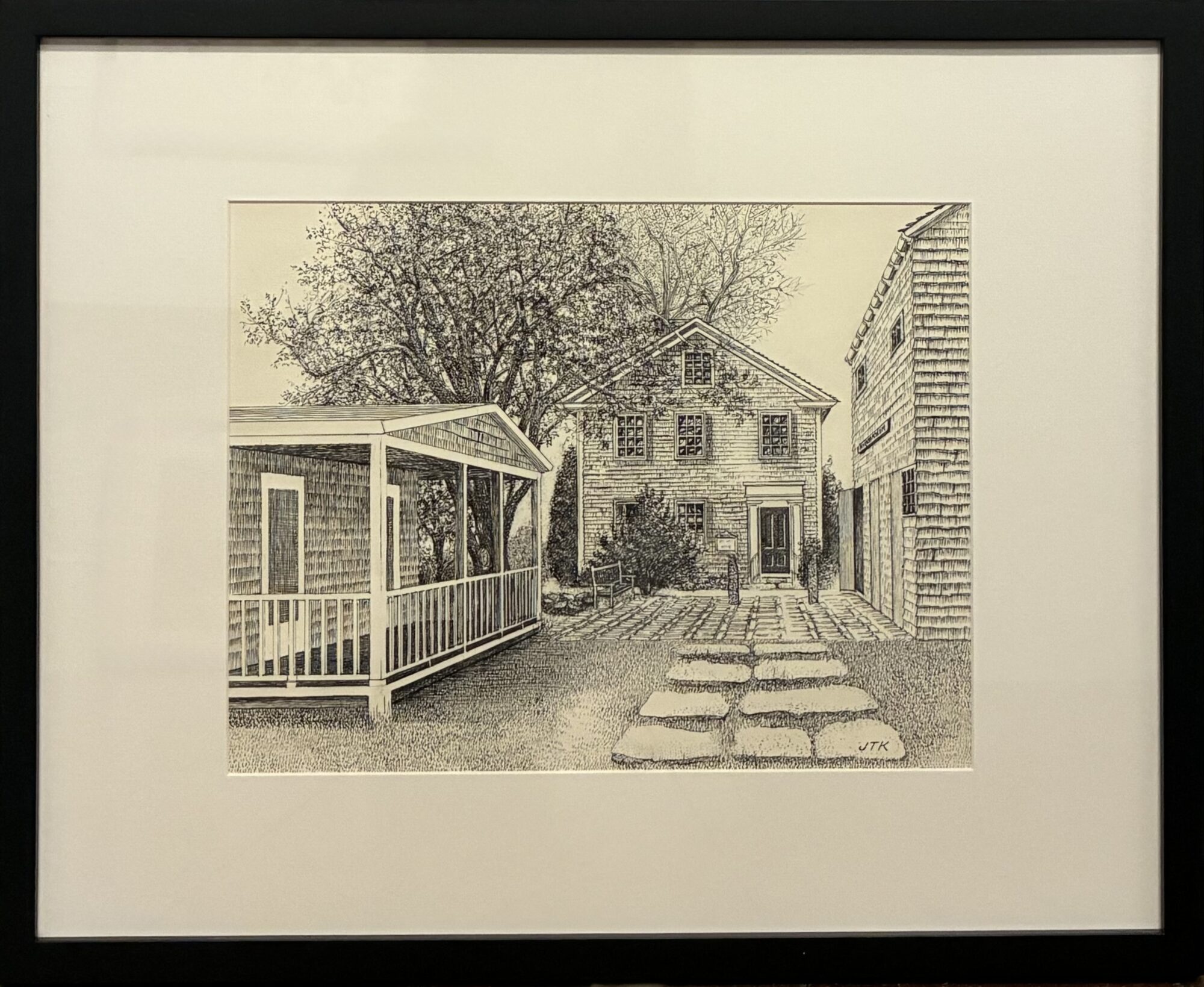
Joan Kanwisher
Bradley House, ca. 2001
Joan Kanwisher (1924-2019)
Pen and ink on paper
Born in Rochester, New York, Kanwisher lived a remarkably vibrant life. She graduated with a degree in general science from the University of Rochester, trained pilots in a flight simulator during World War II, and was a lifelong international adventurer. She moved to Woods Hole in 1952 with her husband, John, a marine biologist and inventor.
She taught herself to sketch using her daughters as models, and eventually found her signature pen-and-ink style, once saying of her work, “I liked the fact that you can create an image with paper and pen and that’s all.”
Kanwisher’s exquisite drawings of landmarks around the village grace the museum’s 2002 cookbook, Woods Hole Cooks Something Up: Recipes from a Cape Village. This beautifully detailed piece, which is reproduced in the cookbook, depicts a view from outside our door.
Kanwisher’s contributions to the village and the Town of Falmouth were significant. She was a champion of the Shining Sea Bikeway, which opened in 1975. In 2015, a mural was installed at mile 3.5 dedicated to her. Kanwisher was also instrumental in founding the Falmouth Artists Guild (now the Falmouth Art Center) and donated many of her drawings to the Falmouth Housing Trust in 1989.
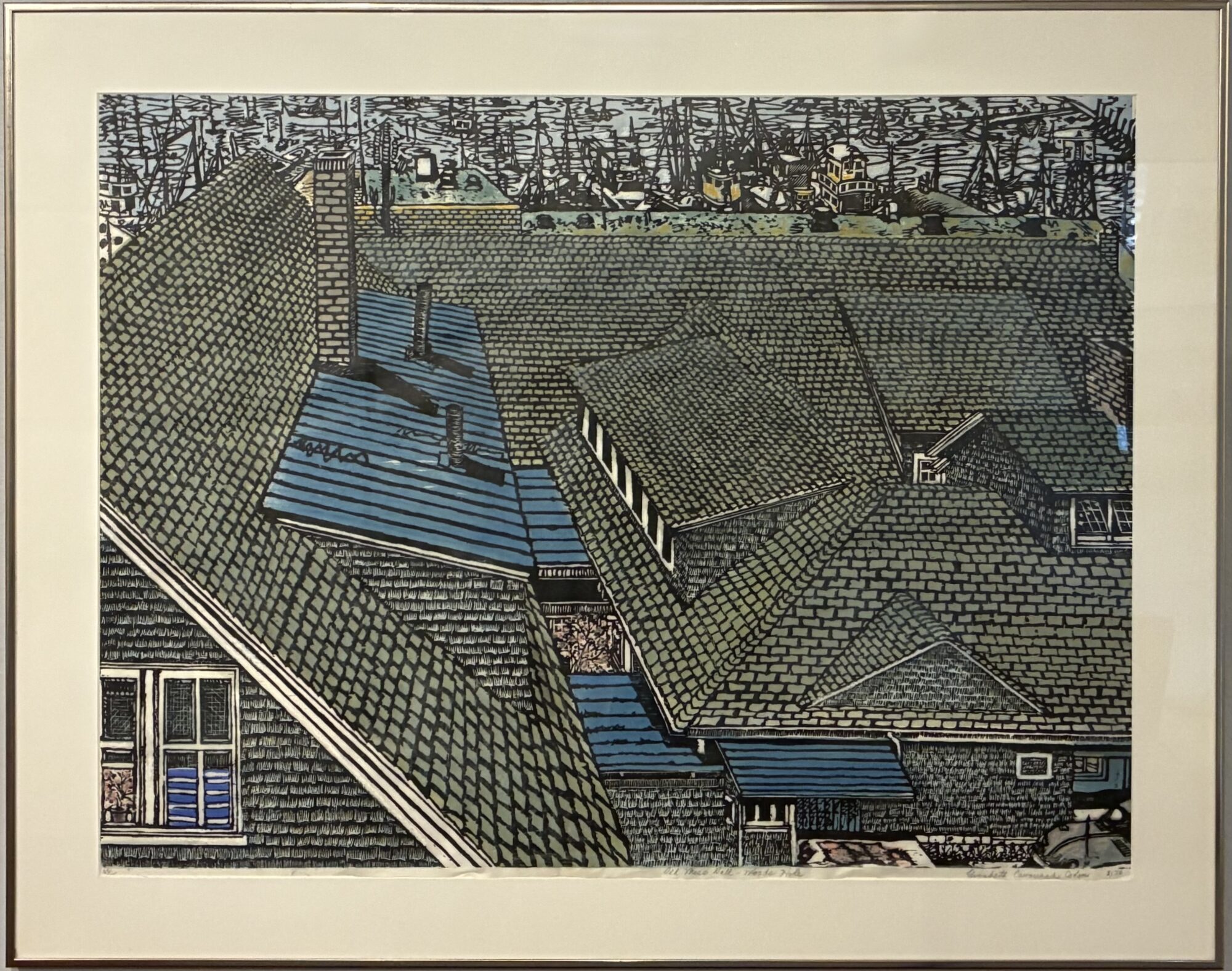
Elizabeth Cavanagh Cohen
Old Mess Hall – Woods Hole, ca. 1960
Elizabeth Cavanagh Cohen
(1924-2016)
Woodblock print on paper
On loan from the family of Marcella and George Katz
Cohen was a lifelong resident of St. Louis. She graduated from the University of Wisconsin in 1947 and received a master’s degree in social work from Washington University in 1949. She was an environmentalist and an advocate for civil rights. She met her husband, Dr. Adolph Cohen, at the St. Louis Ethical Society and after her marriage pursued the visual arts. She was an active member of the St. Louis Artists Guild from 1970 to 2010. Her masterful body of work includes paintings and prints that reflect the changing urban and rural environment.
Connected to Woods Hole through her husband, who conducted research at MBL sporadically from the 1950s to 1970s, Cohen sold her work locally at the Bruce Gallery on School Street. In this woodblock print, Cohen depicts the Old Mess Hall, which was constructed in 1920 and used until 1971, when MBL opened a dining room in the new Swope Center overlooking Eel Pond.
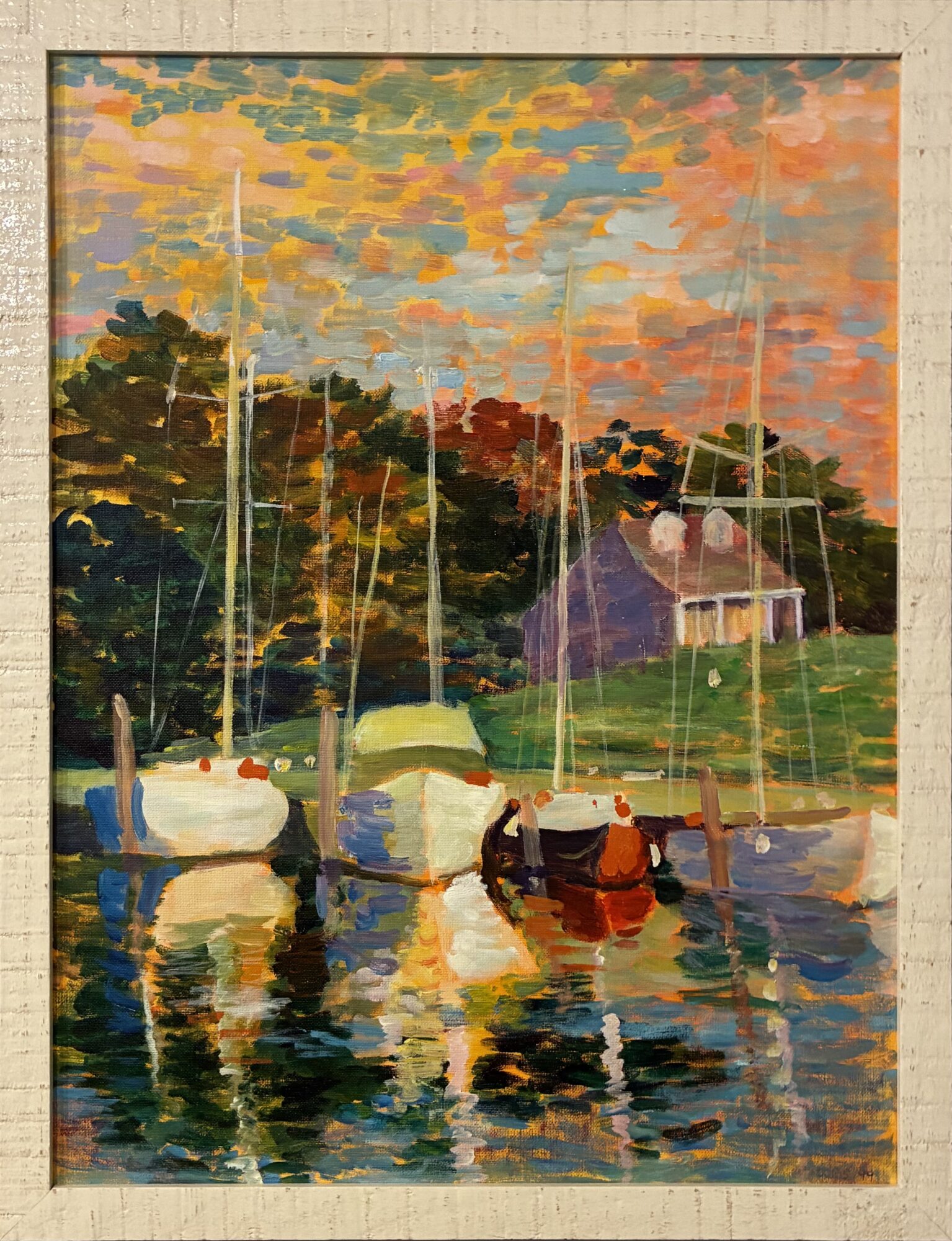
Doris W. Epstein
Boats on the Water, 1999
Doris W. Epstein (1924-2024)
Acrylic on masonite
“Color is a priority,” Epstein said of her art, and this painting speaks to her strong use of color and the vitality and strength of her work.
Originally from Milwaukee, Epstein became connected to Woods Hole through the career of her husband, Herman Epstein, a biophysicist who led several studies on the cause and treatment of Alzheimer’s disease at MBL. The couple spent summers here beginning in 1966 and moved here permanently in 1989.
Professionally, Epstein was a practicing psychotherapist with a B.A. from the University of Wisconsin and an M.A. in social work from Case Western Reserve. After retirement, she devoted herself to her painting, showing often on the Upper Cape, and was very involved civically. She was a board member of the League of Women Voters, served on Falmouth’s Human Services Committee, and was instrumental in the revitalization of the Falmouth Artists Guild, now the Falmouth Art Center.
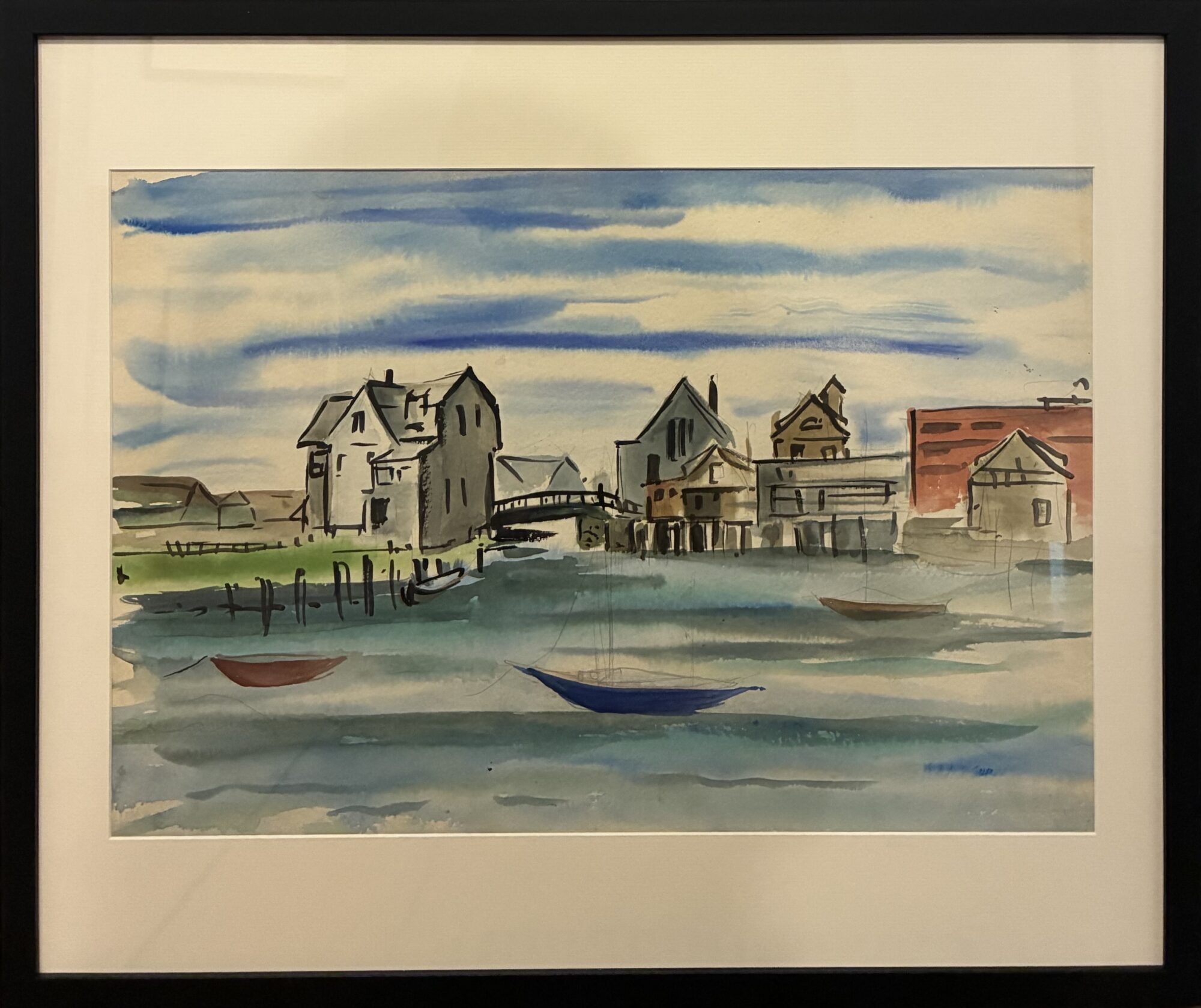
Mary Mavor
Eel Pond Bridge, mid-20th century
Mary Mavor (1925-2005)
Watercolor on paper
Eel Pond Bridge is a well-known landmark of Woods Hole. It was first built in 1914 to span the Eel Pond Channel and has been replaced three times. This painting captures a view from Eel Pond. It was likely painted before 1962, as the WHOI Redfield Laboratory, which was built that year, is missing from this piece. According to Mavor’s daughter Salley, also an artist, she would purposefully leave pencil sketches on the canvas, as you see here.
Mavor was born in Providence, Rhode Island. She studied art at the Rhode Island School of Design, graduating in 1947. She summered in Woods Hole starting in 1950, and moved full-time to the village with her husband, Jim Mavor, an engineer at WHOI, in 1961.
Mavor was an active member of the Falmouth Artists Guild (now the Falmouth Art Center), owner of the former import store “From Far Corners,” and was known for her paintings, pastels, batiks and knitted Nordic hats that she made for friends and family on special occasions. In her coy manner, Mary encouraged people to dance. She organized weekly international dances at Woods Hole Community Hall, loved Scottish and folk dancing and was a co-founder of the village’s May Festival.
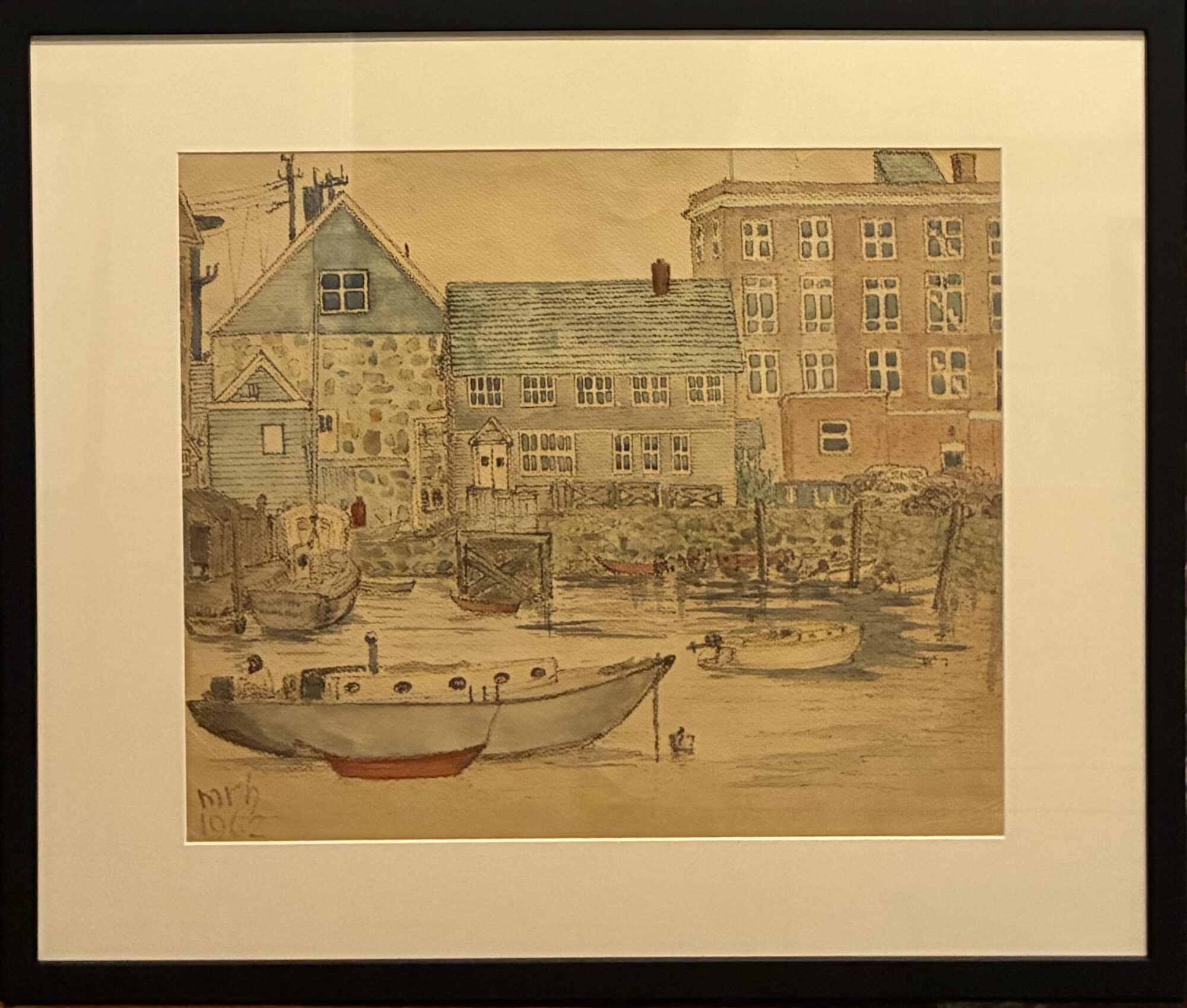
Myra Porter Rankin Chapman Russell-Hunter
View of the Marine Biological Laboratories, 1962
Myra Porter Rankin Chapman Russell-Hunter (1926-1990)
Watercolor on paper
Trained first as a musician, Russell-Hunter began her visual art career painting portraits. For the last 30 years of her life, she focused on landscape painting in her home state of New York and in Woods Hole, where she spent summers with her husband, W. D. Hunter-Russell, a research biologist. A native of Scotland, Russell-Hunter became a U.S. citizen in 1968. She exhibited her art in galleries in Scotland and New York, as well as Falmouth and Woods Hole. Her works were sold locally at Market Barn Gallery in Falmouth.
This beautifully intricate watercolor, with touches of vibrant red, depicts MBL buildings from the vantage point of Eel Pond—a favorite subject for the artist, who produced more than 150 watercolor paintings of the beloved Woods Hole site. At center is the Supply Department (now the Marine Resources Center), MBL’s home for specimen collecting. On the left is the 1836 Candle House, originally used in the whaling industry; the Lillie Building is at right.
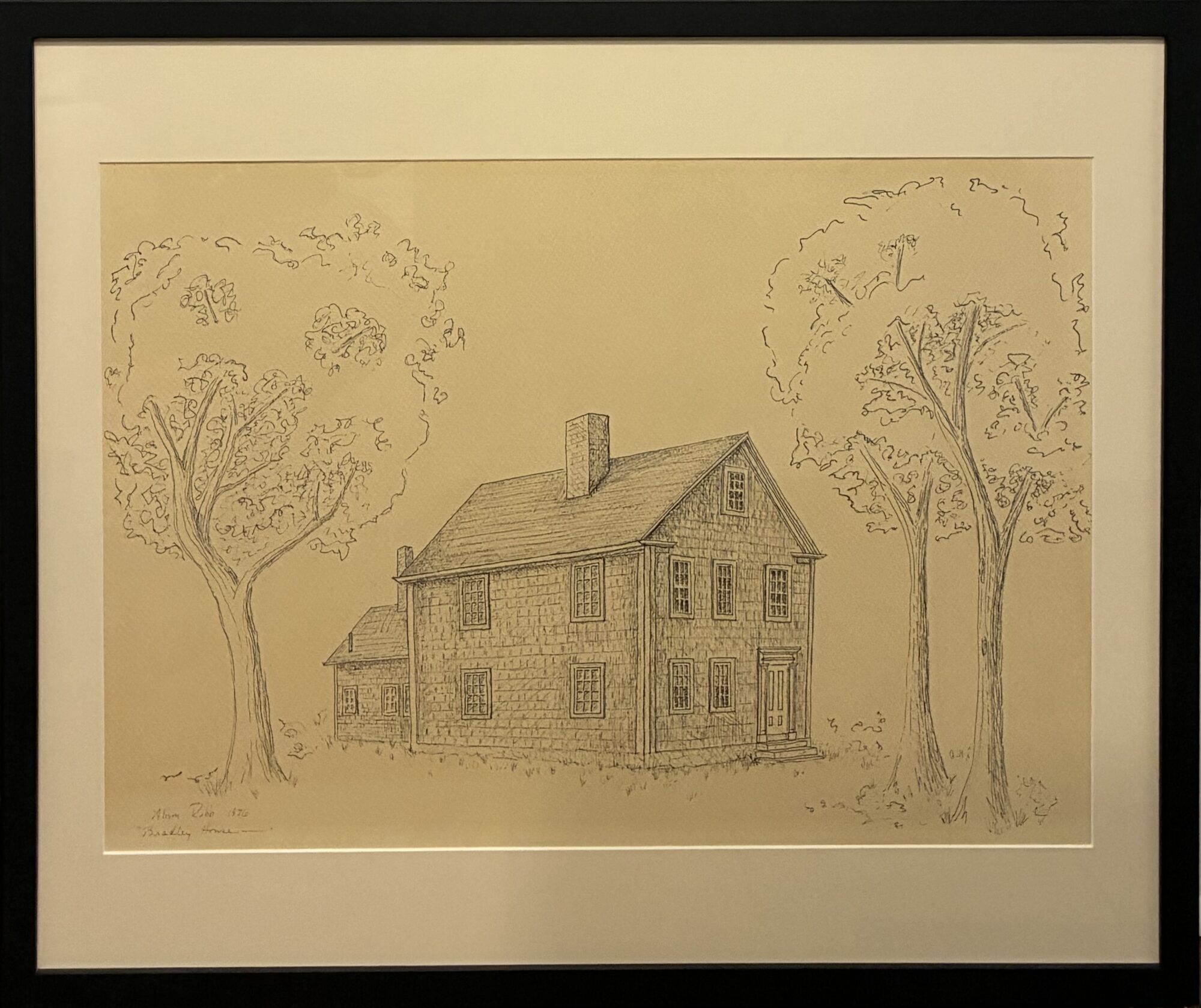
Alison Robb
Bradley House, Home of the Woods Hole Historical Museum, 1976
Alison Robb (1931-2022)
Pen and ink on paper
Robb was an artist, photographer, writer and naturalist. She became the founding archivist and curator of the Woods Hole Historical Collection (now this museum) in 1976 and was an active member of the museum until her death. In this piece, she depicts the museum’s Bradley House—the building in which you are standing—with great detail.
Robb grew up in Worcester, Massachusetts, and spent summers with her family in Woods Hole. She studied art at Briarcliff Junior College, earned a bachelor’s degree in English literature from Boston University, a master’s degree in library science from the University of Pittsburgh and a second master’s degree in environmental science from Antioch University, New England. She moved permanently to Woods Hole in 1972.
Soon afterward, she founded the nonprofit organization Nature’s Circle, enthusiastically bringing people together to learn about birds, butterflies and plants. She was an active member of the Falmouth Artists Guild (now the Falmouth Art Center) from its establishment in 1966, and especially enjoyed painting boats and other scenes of Woods Hole. She was a talented Scottish dancer, dedicated tennis player and expert sailor, loving her Herreshoff sailboats, Daphie and Sandpiper.
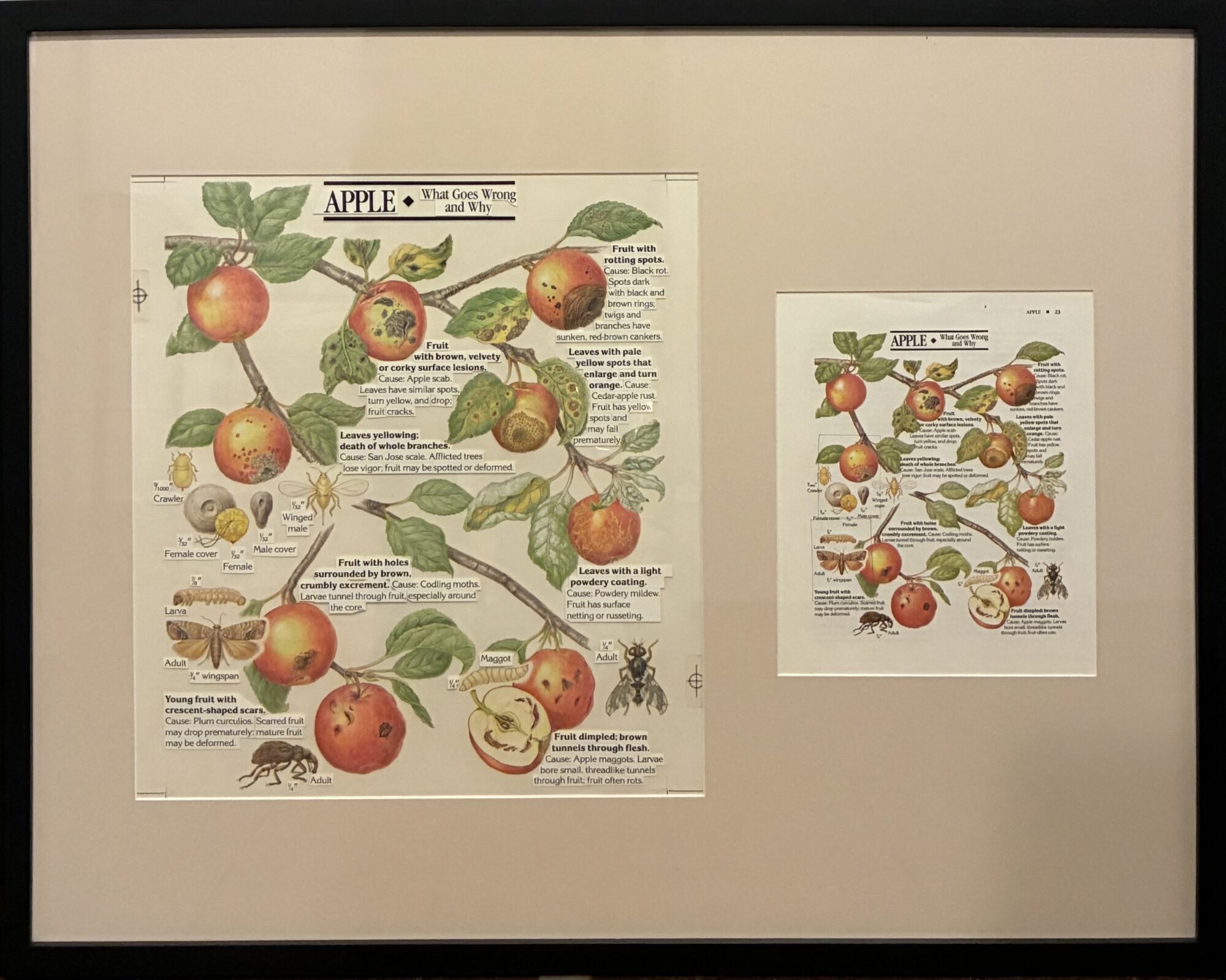
Julie S. Child
Apple, What Goes Wrong and Why, ca. 1992
From “The Organic Gardener’s Handbook of Natural Insect and Disease Control” (Rodale Press, 1992)
Julie S. Child (1934-present)
Colored pencil and graphite on paper
In the 1990s, Child worked with Rodale Press to create plant and insect illustrations for a series of gardening books, among them this drawing of apples on a tree branch.
A summer resident of Woods Hole since the 1940s, Child received a graduate degree from the Massachusetts General Hospital School of Medical Illustration. While working at MBL as a scientific illustrator, she met her future husband, Frank, a biologist. The couple moved to the village year-round in 1994. A professional artist, illustrator and educator, Child taught biological illustration at the Children’s School of Science (CSS) for 17 summers, and continues to impart her love of nature and drawing to adults fortunate enough to attend private classes.
Her impressive skills and generosity of spirit are evident in the beautiful gifts she has bestowed on the community. Her artistic hand drew the MBL’s seal with two seahorses, CSS’s logo and the Woods Hole Woman’s Club’s picture of a bee with Black-eyed Susans. In 2002, she co-edited the museum’s cookbook Woods Hole Cooks Something Up. Recently, she donated over 500 drawings to the museum, thus designating this institution as the primary repository of her art.
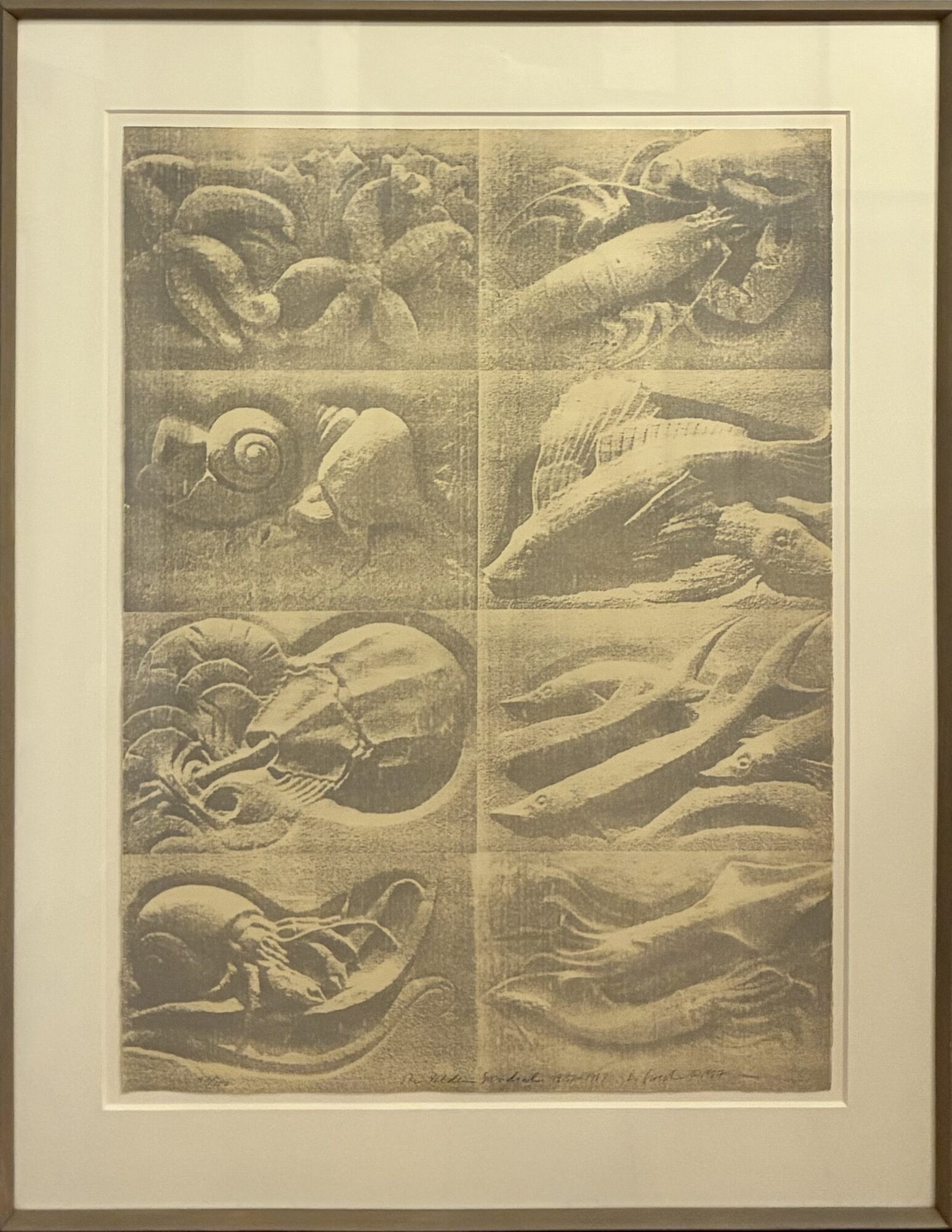
Laura Grosch
Yalden Sundial Relief, 1987
Laura Grosch (1945-present)
Lithograph on paper
This lithograph, a totem that seems captured on a foggy spring morning, places us at Great Harbor to consider the sea and the profound effect of science on Woods Hole village. It is composed of images from the Yalden Sundial in Waterfront Park, which was designed by J. Ernest G. Yalden and given to MBL in 1937 by philanthropist Charles Crane.
An award-winning printmaker and painter, Grosch was born in Worcester, Massachusetts, the daughter of scientists Daniel and Edith Taft Grosch. She is a graduate of Wellesley College and studied at the University of Pennsylvania. Her art has been greatly influenced by the colors and patterns of the natural world. She writes, “As in all aesthetic decisions, the positive and the negative space dynamic determines my choices.” Her works are in collections across the United States, including the Smithsonian, as well as in Europe.
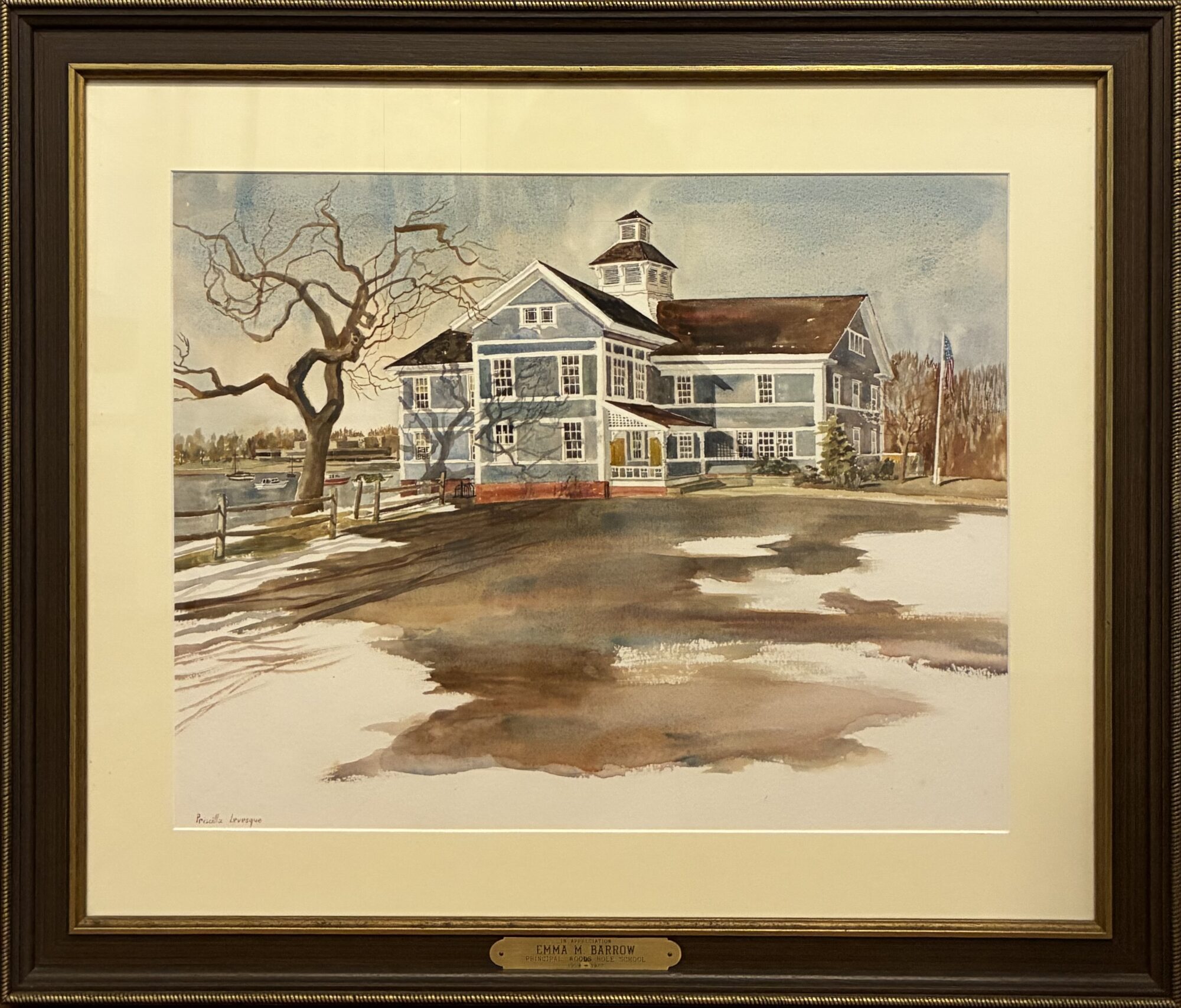
Priscilla Levesque
Woods Hole School, ca.1977
Priscilla Levesque (ca. 1947-present)
Watercolor on paper
Priscilla Levesque was born in Ashburnham, Massachusetts, and developed an interest in the arts at an early age. She earned a B.F.A. from the University of Massachusetts, Amherst in 1969 and resided in Cataumet for 37 years.
A currently active artist, Levesque worked for years with transparent watercolor and recently has adopted casein, an opaque water-based paint, as her primary medium and pointillism as her technique. She resides in Lowell and works out of Western Avenue Studios.
This beautiful rendering of the Woods Hole School was a gift for Emma Barrow, the school’s longtime principal. Located on School Street, the school was built in 1870 and expanded in 1885. It was in operation as an elementary school for generations until its closure in 1982 due to declining enrollment. The building was placed on the National Register of Historic Places that same year, and every summer, the Children’s School of Science continues to teach students there.
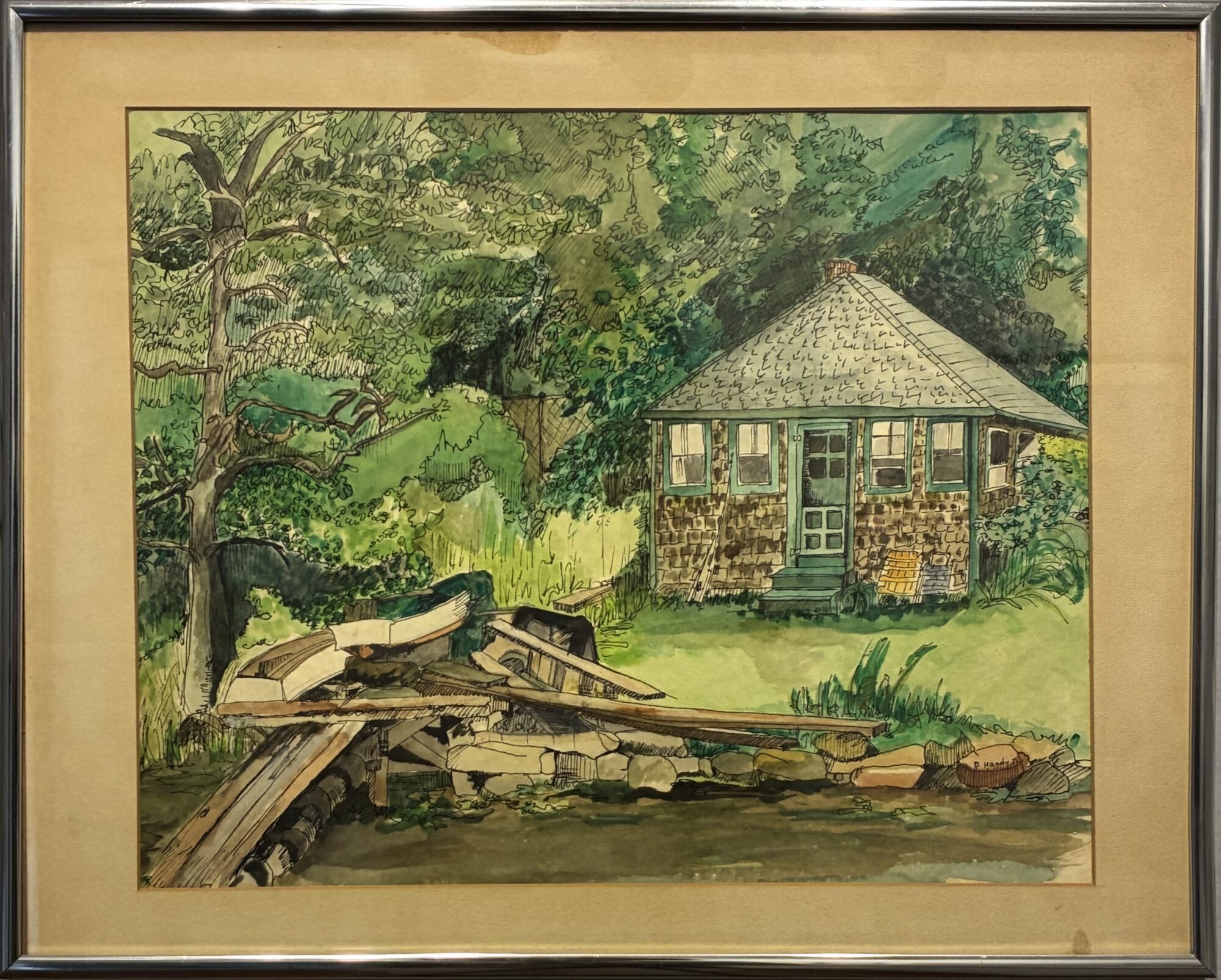
Deborah Handy
Eel Pond Cottage, 1972
Deborah Handy (1952-present)
Watercolor and ink on paper
On loan from the family of Marcella and George Katz
Deborah Handy, a professional artist and Woods Hole native, painted this charming watercolor when she was 20 years old. It depicts the Katz family cottage located on Eel Pond, which the family rented every summer for nearly 45 years beginning in 1963.
Owned by Edie Bruce, who had a residence and art gallery just above on School Street, the cottage provided picturesque subject matter for Deborah, who spent a portion of her high school and college years looking after Bruce’s daughter, tending the gallery and deciding to become a professional artist, thanks to Bruce’s encouragement.
Earning a B.F.A. in fine arts and a master’s degree in teaching from the University of Massachusetts, Amherst, she subsequently taught elementary art in the Mashpee schools. For a time, she owned and operated Accent Picture Framing in the Cape Cod Mall, before relocating the business to her home in Mashpee. A practicing artist for over 50 years, Deborah has won first prizes in watercolor from both the Yarmouth Arts Council and the Falmouth Artists Guild. Currently, she participates in the Falmouth Art Center’s programs.
Video tour of the main gallery of the Women Artists of Woods Hole exhibit in the Bradley House.

Artist Laura Grosch with her work Yalden Sundial Relief in the museum gallery.
Summer 2025 Exhibit Committee
Julia Depp
Anne Halpin
Colleen Hurter
Martha Ellen Katz
Charlotte Emans Moore
Jane Parhiala
Sally Piccini